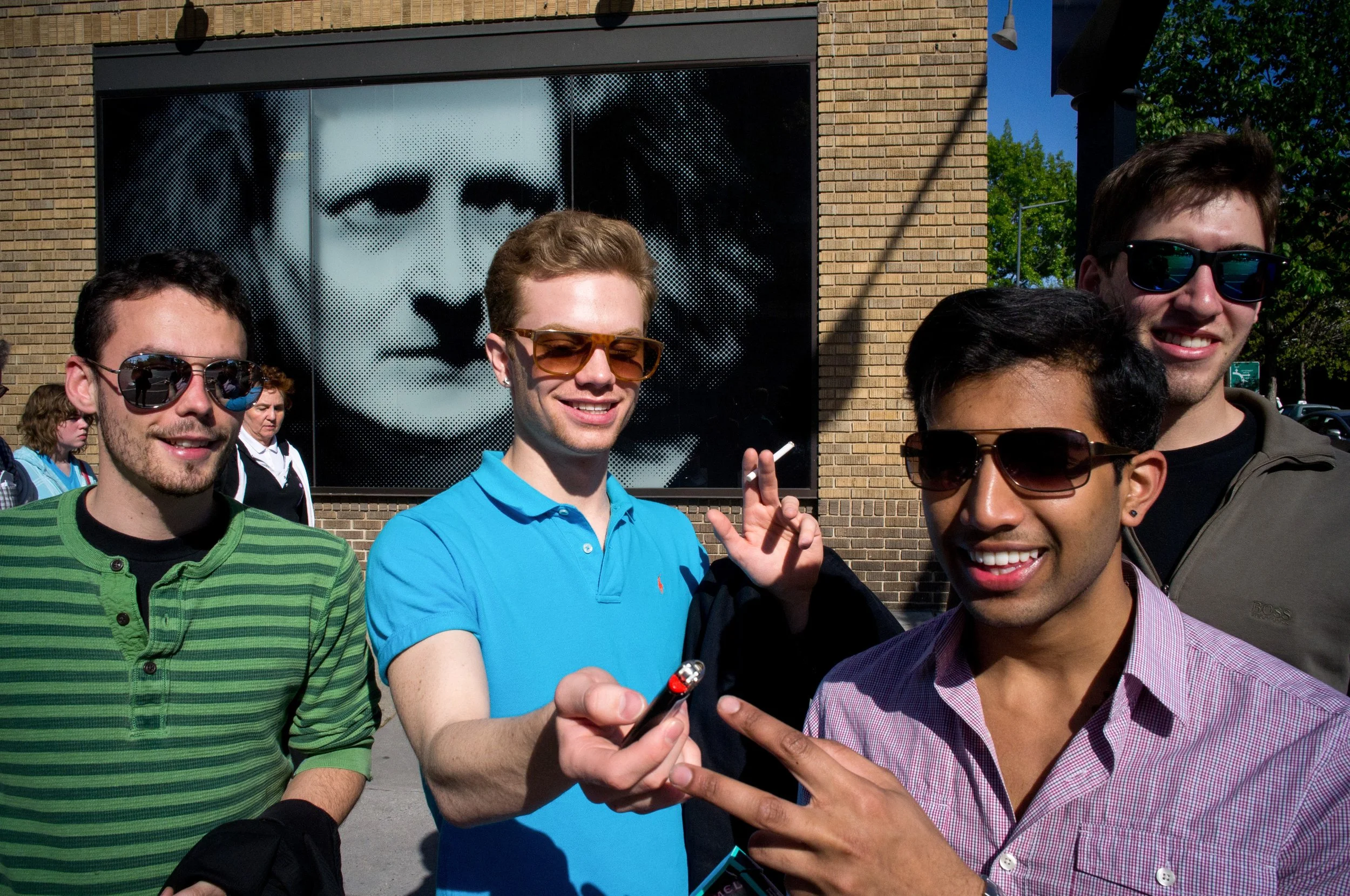
Yesterday:
Today:
End of an era.

Yesterday:
Today:
End of an era.
I have to say I’m really liking using RSS again. I’m using the Feeder app, which is free and not hard to figure out how to use. It’s great for following independent news/info voices in one place. For me that’s rock stars like Rebecca Solnit, Heather Cox Richardson, Anne Applebaum, Jessica Berlin, Marisa Kabas, Alt National Park Service, and many others.

What I’d love to move towards over time is using this blog as social media. I’m already doing a post-here-first strategy, at least for my writing and photos, but maybe need to consider more social-type posts (like this) as well.
That way if you want to follow Bill, you come here. And bye bye Meta.
I just started rolling out my new project, Postcards from America. Here’s the first batch of six. On Mon-Wed-Fri I add an image on my blog, and crosspost it to my homepage and the Prints gallery. Black-and-white but a bit of color as well. Over time there will be a lot of Washington DC-area shots since that’s where I’ve lived and dug into life the most.
I think of these as alt-postcards, obviously not the standard sugarcoated view but something more personal, authentic, and hopefully magical from inside the American lived landscape. My daughter’s third birthday is in there. Lovers in a New York City restaurant. The Christmas tree my mom’s late partner rigged up on a diving platform so his dying friend could see it from his bedroom window, then it became a yearly community tradition.
While it’s just starting it’s already gotten me thinking - not just about my work but my country. I’m living abroad but pretty fixated on America right now. I’m bracing to return soon to a home that has changed in my absence. I’m writing and posting to help me process, to work out how to go forward creatively while staying afloat and being helpful to others.
I can assure you I’m rested and ready to be helpful.
Unlike projects I’ve shot with a particular idea in mind, Postcards is a reimagined, retroactive compilation of older photos from my photographic life in the US, part of a recent deep dive into grappling with my archive. Outtakes from assignments, projects, personal walkabouts, dinners, weddings, etc. Everyday life.
Even when I was on a job, I usually looked for photos for myself, little vignettes that just felt right to me (even if the client wouldn’t necessarily agree). Now I’m going back and finding them again, to see what kind of vision or idea they add up to, if any.
Obviously part of that is asking myself if they are any ‘good’ as photos. Sometimes it takes quite a while to know. I’m discovering how your perspective changes with the times, and can alter the way you interpret your own work. To me, the best photos often can universalize beyond their original context. So in that way a photo from a wedding or Washington DC can also reflect America more broadly.
I see them as people, places, and things I was fond of, following my enchantments. But as we cross a kind of rubicon into a new American reality, they also serve as time capsules from the before-times.
I can’t help but feel like an anthropologist, or an archaeologist sifting through evidence:
This is who we were. This is who I was. How did it lead to where we are now? Are there clues? What do they mean?
Which makes me think of The White Ribbon, director Michael Haneke’s bleak but masterful 2009 black-and-white film. It drops us in a German village just prior to WWI, where strange, even disturbing things are happening. A barn burns. People are injured or even killed in freak incidents. People disappear. We get fleeting hints of cruelty and abuse under the seemingly stable surface of life in the village. While blame begins to fall on the local children, there is never a clear resolution.
Nothing ever really adds up. Like in life, especially these days.
I remember reading about how the film was meant in part as a way to look back at pre-war Germany and the seeds of what was about to arrive. How did Germans, these people we see going about their business in the film, become what they became? What caused their ‘break’, some contagion? What about us? What contagion has caused our ‘break’?
I don’t suggest that my photos have such dark foreboding. So far I think there’s love and beauty and even some humor in them, at least that’s how I see them now. Not nostalgia exactly, maybe a wistful affection for what was and can maybe be again.
Despite everything, I’m coming back still hopeful and a stubborn optimist. While I’m looking back with these photos, of course you can never go back, and I wouldn’t want to.
I’m fighting for what’s next.

Chesapeake Bay

Somewhere in Virginia

Stockholm. Sweden is one country pushing for encryption restrictions - or even bans - that would undermine apps like Signal. (Image available in the Prints gallery)
Important tech edition today for guarding your privacy. Two main things.
First, you need to know it appears that social media platforms are being monitored by the US government. That’s actually not new but it’s ramping up as part of the hunt for people to deport. Mostly related to Gaza/Hamas and foreign nationals for now but who knows where it stops.
My understanding is they are scraping *public* posts. But it’s interesting that WhatsApp is on the list. It doesn’t mean they can read your messages, which are encrypted, but does mean your data that WhatsApp collects (for example who you contacted and when) is also accessible via these tools.
Don’t make it easier. For example, if you post on FB please try to avoid posting with Public status. The value of FB is that you can post to your friends. Not sure if that’s foolproof but better than handing it to them.
Second, I came across an article on Wired that you really should read in full. It turned a lot of my assumptions about encryption, including Signal, upside-down.
Yes, Signal is safe and is considered the gold standard of mainstream encrypted messaging apps. I know that regime officials in the US like Mvsk use it to coordinate their plans and activities.
But the question is where things are heading. That gets convoluted quickly.
Ready for your head to swim?
In the US, law enforcement that used to oppose encryption (since criminals and bad actors can also hide) now suggests that people use it if at all possible. So far that hasn’t seemed to change under Trvmp.
In Europe, generally a bastion of digital privacy rights, many countries actively oppose encryption (because of criminals and bad actors) and would like to undermine it. There is a deep split between countries like Germany that believe the personal privacy afforded by encryption is sacrosanct, and others like Spain who would like to ban encryption altogether for the sake of law enforcement.
Most proposed European legislation revolves around whether to allow governments a ‘back door’ to your encrypted messages, or perhaps to create a way for authorities to access scanned copies of those messages if they so desire. The UK already tried to strong-arm Apple into creating a back door (iMessage is encrypted), unsuccessfully for now at least. Sweden of all places has been mulling similar laws that Signal has said would make them abandon the country.
At best I can determine, those EU countries on the side of encryption are winning, but not by much.
It’s easy to imagine the US deciding to target Signal - a US-based independent nonprofit - if it becomes a last sanctuary of free, private speech. They could decide to ban or block it, as Russia did recently during the Ukraine war. Or simply revoke their nonprofit status on dubious grounds.
What to do? Which basket to put your messaging eggs in, US or Europe? I have a recommendation as all this plays out:
Both.
1) Please get on Signal if you haven’t yet.
Signal is the new baseline, even for everyday communications. It’s considered by most people to be the best combination of top-notch security and good user experience. At the moment there is no threat to Signal that I’m aware of, only speculation of what the US government might decide to do in the future.
2) Get a Europe-based messaging app as a backup option.
In the same way that you should consider following non-US sources of news, you should consider where certain essential apps like messaging are based. The US is facing the unpredictability of what our authoritarian slide could bring. Europe is in better shape in that regard but there is future regulatory risk to encryption generally. [See update below or here]
There are several encrypted apps based in Europe that rival Signal. I would say few can match Signal’s combo of security, quality, features, and ease of use for those who don’t want to think too much about these things. But they’re all different and have their own pros and cons.
So which one to get? I did some extra research last night, digging into various reviews and comparisons where you get true geeks nerding out over this and that difference between apps. Spare yourself the aggravation.
I got it down to two, then one winner emerged.

Threema is the closest to what I would call the European equivalent to Signal, with strong security protocols and a nice UI. Like Signal (and unlike WhatsApp) it doesn’t collect your data in the first place. It’s Swiss-based, which is a real advantage based on their strong laws around internet privacy. The Swiss don’t mess around, I didn’t see Switzerland on the list of countries pushing to weaken encryption. It is highly unlikely they will throw you under the bus at the behest of other governments.
Security-wise they seem pretty comparable. While Signal’s encryption protocols are seen to be the best, the app is not perfect. Critics say requiring a phone number for signup is a fundamental privacy liability. With Threema you can signup anonymously. You can choose to associate your contact info with your Threema profile, or not.
One small feature I like compared to Signal is that Threema actually has a contacts list tab. With Signal you can’t browse your contacts until you start a new message.
Maybe the main real drawback to Threema is that it costs six bucks on the app store. Might be a dealbreaker for some people. I see it as a positive, as it locks in their funding source. Signal relies on donations.
I had been ready to recommend one or two other strong contenders, like Matrix/Element, but for various reasons they didn’t seem as promising for popular adoption. Also Threema seems more polished and ready for primetime than some competitors.
While it’s fairly popular in Europe - several million users, though I’ve seen different numbers - you likely won’t find any of your peeps there at the moment (I had one, a security-conscious European friend). That’s ok. I think the important thing is to have an option for at least your inner circle in case Signal falters.
And for as many people as possible to agree on which option so we can find each other. I vote for Threema. I’m there already, find me if you take the plunge.
Update March 21, 2025: Important news from EFF (Electronic Frontier Foundation)

Baltimore, MD

Washington DC
Photo illustration by Bill Crandall
As of yesterday all staff at Voice of America have been put on administrative leave. Other entities like Radio Free Europe/Radio Liberty and Radio Free Asia lost their funding.
What’s VOA? Not a dumb question if you’re in the US, as it has been radio and TV news for a global audience (hundreds of millions per week) and isn’t even available in the US except on the web. Read more on the background and yesterday’s announcement here. The Reuters story talks about ‘gutting’ VOA et al and how it is ‘unsalvageable’. Yet the article goes on to say VOA will be not destroyed outright but stripped to the bone, to the minimum required for basic functioning required by law. So I suppose they mean to put everyone on leave until they can decide what skeleton crew to bring back for a VOA fit for purpose, for the New Way. But that’s just speculation.
It’s a very sad day. VOA and Radio Free Europe are strictly not propaganda, no matter what anyone says. They were created to combat authoritarianism through independent, fact-based journalism. Bias is in fact not tolerated. For many in the world, they have long been respected, often the best source of quality, balanced news coverage in regions where that was in short supply.
Just a few days ago, before the hammer fell, I was in downtown Nairobi and had a chance to peek inside the famous Chester House, the old building where many of the big foreign news agencies were once headquartered for decades. All except one moved out years ago into new digs elsewhere, including VOA, but it was cool to see such a legendary place. It was also poignant, like a ghost of the past.

Voice of America in DC was just about ready to move from its aging headquarters near the Capitol into a sparkling new building that had been in the works for years. Last week it was deemed an example of waste.
REM’s “Radio Free Europe” has been my song of the day. Especially the bracing live version on their 1983 TV debut on Letterman. Energy crackling through them, especially guitarist Pete Buck who looks like he’s being electrocuted. Four dudes from Athens GA that shaped the musical landscape and the very image of America for decades.
Soft power. I’m with them.
~
Decide: defy the media too fast
Instead of pushing palaces to fall
Put that, put that, put that up your wall
That this isn't fortunate at all
Radio station: decide yourself
We're calling out in transit
Calling out in transit
Radio Free Europe
Washington DC
New York City
There is no single reality in the US. Americans all walk through life in bubbles of their own imagining and experience. Postcards from America - inspired in part by Heather Cox Richardson’s daily Letters from an American - is mine.
Yet in some ways Postcards is the opposite of HCR’s approach. First of all, obviously they are photos not writing. They are not comprehensive or objective and my goal is not to celebrate or denigrate or even to specify. They are instinctual not rigorous, indirect not precise, fleeting but still hopefully contain something enduring or revealing. More questions than answers. These will be personal photo dispatches from my years as an observer trying to understand America better and bottle those imaginings.
I’ve always been somewhere between a US critic and idealist. It’s a shame, recently I was more comfortable than ever with my country.
Until… you know.
It will be just the photo, no text other than the place, no dates or explanation. You can form your own ideas and interpretations. I simply want to reflect back a small slice of what has resonated with me in the US, and maybe it will resonate with you. And, translated more broadly if you’re so inclined, a reminder of what America was, is, and can be.
In normal times this might be a harmless or even naive exercise. At the moment, asserting the quiet beauty and intrigue of little everyday American moments (at least as I see them) from the Before-Times feels punk rock. Defiant. Maybe even painful, as they become markers of what we stand to lose, and have already lost. There’s some mourning in that sense but I’m a stubborn optimist. I hope they also offer something to hold on to, to claw back to.
This newsletter had its origins as advocacy for climate action through the arts. Then noticing the steady creep of right-wing thugs on the march. Now here we are, wondering what will become of the American experiment. We are at the barricades. We are the barricades. Anything we can do now to stand up for good is worthwhile. This is one modest thing I’m doing. Hope you enjoy and share it.
A few logistical points:
I will add these photos three times a week for a while to the best of my ability. If HCR can handle writing each day, I think I can do this. You can see them several ways on my website, which I am trying to make as dynamic as possible with weekly updates. A place you may actually like to revisit on a regular basis.
They will appear on my Notebook blog, where you can use RSS to get your daily dose. (I love RSS, I just started using it again with the Feeder app. The RSS link is at top right.)
They will also rotate every other day or so as the nice big lead photo on my homepage (right below where you can check the weather in Greenland) if you prefer to just bookmark billcrandall.com and visit when you want.
Then they cycle into the Postcards from America section of my Projects page, so you can watch the body of work build in real time.
I will probably also add them to the Prints gallery in case you want one.
I won’t send each of them out by email, that would be way too much. I’m thinking I’ll include them as a weekly batch of 3-4, on their own or included in another post.

(all photos made on November 7, 2024)
So often when photographing out in the world, I pray to the photo gods.
It’s important because many things have to fall into place for a decent photo. Sometimes you just pray for something, anything, to work with. You pray for good light. You pray for moments and serendipity. You try to not screw up if those things do find you.
Sure, you can manufacture something. But there are ethics in photojournalism and documentary work, one of the primary directives is no fake/directed action. I never did that. Either it happened or it didn’t, and either you got it or you didn’t. If it’s fake, it’s nothing, a bit of theater. The power is that it’s real, authentic. Even as my work has moved to somewhere between art and documentary, I adhere to this. You become a kind of scavenger, a human divining-rod.
It’s getting harder in the modern world as life gets more conformist, regulated and suffocated, especially now that people live in front of screens. Years ago when I started as a photojournalist for newspapers, I would sometimes get sent out by an editor to find a ‘stand-alone’, meaning an everyday-life photo without an article. Just go find a good photo to fill space on the page.
Even before screens took over, I would drive and drive around the suburbs for hours (with my stack of map books, this was before GPS), frantically searching for anything that looked like a photo op. Something going on, something unusual, some sign of life. All I needed was one good shot.
You try making a picture in strip-mall suburbia.
Then there is Kibera.
I’ve written on Medium before about the vast Kibera slum, the largest in Nairobi and in all of Africa:
Why Africa’s Largest Slum is the Best Place in Nairobi
Ok, that’s a title meant to provoke. But in a city of contradictions Kibera is a Russian nesting doll of contradictions within contradictions. A complex place, defying easy stereotypes.
It has a notorious reputation — even Kenyans are a bit afraid of it — but it has achieved basic services like water and electricity in recent years. Because of its notoriety it tends to get more outside aid projects than other slums in the city, but certain episodes have also bred distrust of outside aid. There are byzantine layers to who controls what areas, but also a fierce sense of community often lacking in the rest of Nairobi.
There is an arts district.
I haven’t been to other slums — there are many in Nairobi — but I am told they are often more tense and get far less aid.
In some parts of Nairobi, you can see the dense medieval cluster of Kibera’s corrugated roofs as you whiz by on a nice roadway, as I did in my Uber ride from the airport when I first arrived here in 2023. I was immediately fascinated and knew I would need to somehow explore it. Which I eventually did, with the help of local friends. It was the privilege of a lifetime to gain access to such an intriguing place, where people are trying to live with stoicism and dignity despite the conditions.
Unlike suburbia, in Kibera everything is interesting, irregular, unregulated, improvised, alive. In its own way it has more vitality and intrigue than most of the world’s great cities. There are phones, but no one is sitting at home on Facebook. Life is outside.
Kibera is difficult to penetrate — you wouldn’t last long walking around, esp as a mzungu (white guy) with a camera, nooo sir — but with the right guide everything is possible. People barely look at you, they know you’re vouched for. My guide was a young painter that everyone seemed to know and like.
My first foray into the massive slum had been overwhelming, overstimulating, there was literally too much that seemed worthy of a photo. The next couple times I settled in somewhat, and had a few chances to get inside the life a bit more.
Then I had the kind of day photographers dream about.
My last visit, this past November 7th, wasn’t special at first.
It was raining hard in Kibera. Our guide had something come up and was a couple hours late, so my friend and I had lunch. It seemed like we might not even walk around at all.
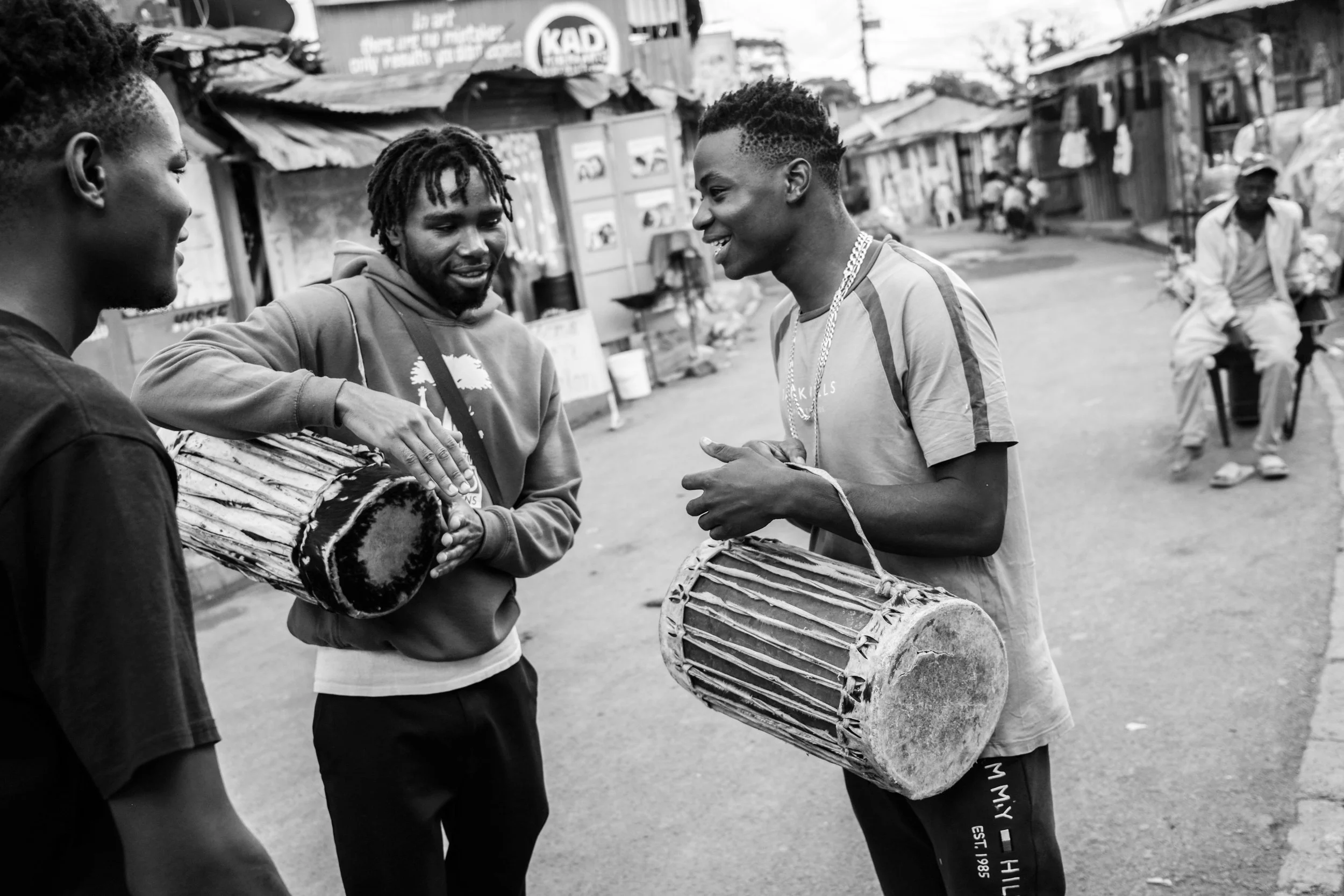
Then we did, and hoo-boy. It may have been the most productive 1–2 hours of my photographic life. I have plenty of other work from Kibera, but all of the photos posted here are from the one walkabout that day. They are all basically street photography, quick-reaction observations. Sometimes I would pause a bit to let things come together, sometimes I barely had to break stride.
I’ve always thought good photography is more like channeling or receiving photos rather than either taking or making them. Usually that channeling happens rarely, when I’m in sync with the flow of things properly. This was like that, but over and over.
In the old days driving around on assignment, I’d be happy to get one good one that I didn’t mind putting my name on. If you got three or four worthy shots in an afternoon it was a rousing success. About the same for my personal work.
In one short outing in Kibera I got almost twenty images that I think hit the spot in some way.
Of course, I won’t end up using all of them. But twenty that I would consider for exhibition. Which I may be a part of soon, at a small gallery in Kibera I’m helping to launch for Kibera photographers I work with.
The photo gods were indeed smiling. Maybe it was their karmic gift for all that time I used to spend searching in frustration.
My father went to art school at Pratt in NYC in the 1950s. I remember he criticized the ‘trash can school’ of art, meaning going out and finding the most rundown person or place you can, taking a photo (or making a drawing or whatever), and calling it art. Exploiting people for their picturesque poverty.
This is especially a problem in Africa, which is maybe the most chronically stereotyped part of the world.
As a general practice, I never set out to make a place look bad or good. Certainly I try to never punch down from a position of privilege. I also try not to fall into sugar-coated clichés of the ‘happy poor’. Getting that balance is the crucial test when photographing places like Kibera. I can only photograph what I like. I look for what is interesting and feels both true and fair to people and places, and I understand that stories are complicated.
If you’re doing it right, photography challenges you to up your equanimity game. Not how to fake it but how to have it. As a well-known photographer once told me, people can see through you. They can see through you THROUGH WALLS.
I want to show that Kibera is interesting and worth caring about in a positive way. I love it and hope that comes through.
As I wrote previously after my first short visit: “what I really wanted to show was the unique landscape and the relationship of people to it”. Which is pretty much what I always try to do.
Kibera is not the bogeyman of dysfunction it is often portrayed as. It’s a fascinating urban organism — and a community. A community full of all kinds of complex problems and life is hard. Still, as I saw over and over, if people stick together with some toughness and care for each other, they can get through anything.
Which is dangerously close to a happy-poor stereotype. Sorry.
It’s the best I’ve got to strike a blow against all the unfolding disasters in the world. I refuse to add to the negativity. Something about a butterfly’s wings.
The former Walker’s Cafe, where James Reeb had his last meal, in 2015. (Photo by Chris Walton, courtesy of Unitarian Universalist Association)
Author’s note
For those who subscribed to me on Substack, I’m still there but now publishing newsletters from my own website.
James Reeb was a white Unitarian minister who, in March of 1965, heeded Martin Luther King’s call for clergy nationwide to join him in Selma, Alabama. The night after turning on the TV news to watch the Bloody Sunday violence against civil rights marchers at Edmund Pettus Bridge, Reeb told his children a bedtime story and got on a plane south from Boston.
He would never see his family again.
A day after arriving, Reeb was part of MLK’s second attempt at a nonviolent march across the bridge, the so-called Turnaround Tuesday. This time the marchers simply gathered, kneeled, prayed, and dispersed, avoiding violent confrontation.
That night after dinner, coming out of what was then Walker’s Cafe — a black-owned diner and one of the few restaurants that would serve blacks or their white supporters — Reeb and two fellow clergy were verbally accosted by several white men across the street.
The men followed and caught up to Reeb’s group a half-block up the street just before the Silver Moon Cafe on Washington Street. Here is the spot:
Silver Moon Cafe, then and now. Washington Street, Selma, AL.
Reeb was hit on the head with a pipe or club of some kind, and others in his group were pummeled. They somehow managed to stagger several blocks to an office serving as the marchers’ headquarters to call an ambulance.
Days later, Reeb died in the hospital at age 38.
That’s the short version of a complex episode in US history. One that was the talk at kitchen tables nationwide at the time, but is slowly fading into obscurity.
Why am I talking about it now?
The former Walker’s Cafe (center). Reeb and his colleagues left the diner and turned right. (Photos from Google Maps)

Directly across the street, where there used to be a row of commercial storefronts, a gang of white men shouted at Reeb’s group, using the n-word, and followed them.

The former Walker’s Cafe is on the far right. The corner building at left and part of the empty lot in the center is where the Silver Moon Cafe used to stand. In front of the lot is a plaque marking where Reeb’s group was attacked as they walked.

With Reeb seriously injured, they walked four long blocks to this building to call an ambulance.
For one thing, as I wrote this from overseas it was March 7th, the anniversary of Bloody Sunday. As I first hit publish, it’s the anniversary of Reeb’s death five days later.
But I also have a personal connection to the story.
James Reeb married my parents.

The room where my parents met in the late 1950s.
In 1959, before moving to Boston, Reeb was the young assistant Unitarian pastor that officiated their wedding at Washington DC’s All Souls Church on 16th Street NW. The church where my parents met in the reception hall, the same room where we had my father’s memorial service in 2010.
But there’s more.
Reeb’s murder did not go unnoticed. Quite the opposite, the national outcry was such that it galvanized public support for the Voting Rights Act, which LBJ introduced days after Reeb’s death and signed into law months later on August 6, 1965.
The day I entered this world.
So, without getting into what has become of the Voting Rights Act more recently, you might understand how I have long felt a karmic connection with James Reeb. His quiet example of equanimity, conscience, and courage has often guided and inspired me. My parents told me Reeb’s story, and I tell my biracial daughter about him as a matter of family lore.
For 15 years I was a teacher and would tell my students his story to make the civil rights struggle more tangible through my personal connection. He’s represented in the 2014 movie Selma. We saw the film on a school field trip, sitting in the dark theater I choked up a bit seeing ‘him’ onscreen.
He died trying to help. Like a firefighter running toward, not away from, the flames. He would find out his white skin didn’t make him fireproof.
When discussing Reeb it’s fair to note that it was a white man’s death that was a game-changer at a time when so many blacks were being killed. But in a way that’s the point. To me, it’s an example of what more white people should do.
No, not get killed. But in a white-privilege society, whites need to stand up for what’s right in whatever way they can. You can’t just leave the oppressed to fight their own battles.
While I always had a fuzzy imagining of how his final moments played out, with a bit of research and an assist from Google Maps images, I came up with this virtual visit to the scene of a hate crime that rocked a country already reeling from the atrocities of Bloody Sunday.
The current desolation of the cityscape is striking. I was shocked the cafe still exists. Then Selma was a more bustling place, with evil just under the surface (except when it was on the surface). Now it appears to be just another dying small town, the block where the events happened is almost completely decimated by time. A town haunted, yet propped up somewhat by civil rights tourism. Hard to imagine where Selma goes from here.
Finally, as a footnote, there was never really criminal accountability in the case against Reeb’s attackers, who did stand trial but locals closed ranks around the accused. NPR has an excellent podcast and audio-visual interactive piece with a fuller exploration of Reeb’s death and the aftermath called White Lies, definitely worth checking out.
If you go to All Souls today, it is still a lively, progressive Unitarian congregation dedicated to social justice and voting rights. Photos of Reeb hang on the walls.

[First published March 12, 2024 on Medium. I’m making a tradition of posting this every year on the anniversary of Bloody Sunday.]
If you’ve seen my posts in various places over the last few months, you know my tech recommendations in terms of digital privacy: Signal, DuckDuckGo, Proton, VPN, no Google, etc. It’s been a fair amount of work making those switches but super satisfying, even a joy. For example, I actually look forward to using the Organic Maps app, the open source alternative I found for Google Maps.
(I won’t rehash all that AGAIN. You’re welcome.)
Another part of the tech equation is where and how to forge a digital home in the Age of Broligarchy.
I haven’t quite left the old house of Meta and Google. I’m still on FB for my friends, until it’s untenable. I deactivated IG/Threads but haven’t deleted yet, in part because once my new home(s) are fully built I hope to get some of those followers to come with me. I’m almost off Google entirely.
I’ve been on a building spree lately on new platforms (some, like Patreon, I’ve built and already abandoned).
Allow me to map out what I’ve been up to. If you’re looking to do some renovations yourself, this might also serve as a useful overview.
billcrandall.com (Squarespace)
After some concern that it was too stuffy and complex, I’m doubling-down on my long-time — and nearly comatose — Squarespace as my home base at billcrandall.com. I’m liking it a lot better since I finally got a grip on its features a bit more.
The landing page is a feed I will update often. I’m figuring out if RSS will work for it but hope you’ll consider old-fashioned bookmarking and check back sometimes. My goal is to work towards a website I refresh almost as often I would social media.
I’ve linked other platforms to my Squarespace as well, including cozy but somewhat obscure ones like Ko-fi, a donations site for creatives. I’ve started using it as an experimental ‘photo cafe’ member space for photography questions, dialogue, feedback, even mentorship in exchange for pay-what-you-can. Or you can just make a donation anytime.
I’ve been working on translating my years of teaching to online material. I’m not there yet but eventually I plan to add a member page on Squarespace for photo dialogue and curriculum, which might one day replace the photo cafe on Ko-fi.
I’ve had people ask me about print sales, something I’ve wanted to set up for quite a while. So I’m now using Darkroom (via Squarespace) for fine-art prints on demand. They do their own shipping, including international.
There is a batch of Nairobi images in there for starters — part of processing the new work for myself — with new ones (and other projects) coming weekly for the foreseeable future.
This newsletter is currently here on Substack, which I like but increasingly I have my qualms. For one, you may have heard about Substack’s ‘Nazi problem’ — that their hands-off approach to content moderation allows actual Nazis to set up camp. Not many, but one is too many. Substack’s co-founder also had some sketchy pro-regime comments recently that for a lot of people raised doubts about whether Substack long-term is the safe sanctuary for creatives that it appears. You can read more here about the curmudgeon case against Substack.
Any of these platforms could screw you eventually, simply as a result of their own success. I’ll probably ultimately move the newsletter to Squarespace. Already I’m cross-posting these posts to my Squarespace blog and longer pieces to Medium.
My plan is to operate as centrally as possible from the real estate I ‘own’ and control. That’s Squarespace. Need a good foundation for a homestead.
Bluesky is going ok. Not the liveliest place, takes a while to get traction, but it’s a good, non-toxic replacement for Twitter. At least it’s not Meta like Threads. I have to say the quality of chatty convo is better on Threads if that’s your jam. Following news and commentators is better on Bluesky and you can organize a feed of just your friends.
The question of digital homebuilding is also different for artists. How to not just showcase your work on a static portfolio site but create a more dynamic space?
How to connect, engage, and even create community?
How to present your work as having relevance and value beyond a click or a like?
As I’m now a former teacher and back to being a photographer (albeit someone who can’t work here in Kenya, and will be unemployed when I get back), these are questions I’m wrestling with.
For starters, to me relevance means combining my images with writing in new ways — both my new Nairobi series and older work that I’m taking a fresh look at — to expand the context, process, and stories around them. Also using archive images to illustrate posts like this one.
Value means offering ways to buy the work and/or support me directly in other ways. Otherwise a website is only the dreaded word for freelancers: exposure (what everyone wants to give you, in the hopes that someone else will pay you).
I hope you’ll find me in my non-oligarch homes. None are fully furnished yet but all are quite presentable, so I’m giving you all the house tours first.
Notice none of them benefit our worst bro overlords. And none of it involves doomscrolling. So more of the time I spend online is actually creative and productive instead of mindless and passive (though the struggle is still real).
If you’re already a subscriber thanks for sticking with me. As a digital semi-nomad (ironically writing about home-building), I hope my newsletter can at least be my small contribution in defense of art and culture and stubborn optimism.
As someone (cough) just put in my new bio on Squarespace, I do have a track record as “a warrior for truth-telling, empathy, community, education, and change through the arts”. Yeah, that’s quite the immodest mantle to claim but it’s true and I have receipts. That’s what I’m trying to build on, especially in this moment.
If you want to support me further, please consider:
- Upgrading to a paid subscription
- Sharing the photo cafe with someone who could benefit from my help with their photography (or signing up yourself so I can help you!)
- Buying a print
For those who actually read this far, bless you. It’s a lot, I know! Here’s the roundup with links:
billcrandall.com — My main Squarespace website, personal blog, print sales, etc
Ko-fi — A photographer support space (also integrated into Squarespace)
Darkroom — Print sales (also integrated into Squarespace and Substack)
Substack — My newsletter on photography, ‘future-music’, and how art can save us
Medium — Longer-form writing
Bluesky — Find me if you’re there
Hope you’ll visit and be in touch. Keep the faith, power on.
14th Street revitalization. The Tweed Ride in Adams Morgan. Thievery Corporation selling out the 930 Club. The Funk Parade on U Street. Halloween block parties in front of our first house in Petworth. The former skate park in Shaw. Bikes everywhere, including the new Capital Bikeshare system.
I was born and raised in and around Washington DC. Looking back, the middle of Obama’s first term, around 2010 or so, has to be considered a candidate for ‘peak DC’ vibe of the last few decades. Of course that’s a loaded concept, as self-proclaimed Chocolate City was and is a long-time bastion of proud black culture, even when the crack-era streets were at their most dangerous. But by 2010 many formerly derelict areas were blooming — as I liked to say, all the places where you used to be afraid to walk you now couldn’t afford to live in — and a buttoned-down government town was entering a phase of new personality and dynamism.
Washington DC, the city where people live away from the monuments and power corridors, is mainly liberal but it’s often the first city that feels the cultural shifts that come with the politics of a new administration. A previous low point in the ‘vibes’ was Bush’s second inaugural. DC was dismal, sullen, on edge as the rhinestone cowboys paraded through town.
By contrast, during the first Obama term the spirit on the street was unmatched. Not just the wildly exultant election-night celebrations at 14th and U Street, which had burned during the 1968 riots after MLK was shot. There was just a sustained mix of joy and relief, a relaxed air, a feeling of moving in a positive direction. Even some of DC’s jarring divisions by race and class began to soften. Gentrification swept the city, creating its own set of problems, but it felt like the city was coming into its own diversity.
Going through my photo archives recently, I came across a number of photos I took around that time. Many of these were outtakes I never used for anything before, or they were made for a magazine assignment and put away. A few of the black and whites are from my personal Fairy Tales from the Fault Lines project that documented the central neighborhoods that were changing fast.
Looking at these images now as period pieces, DC seems a whole other world of pre-COVID, pre-Trvmp spirit and energy. A lost era of optimism.
I’m writing this from Nairobi, Kenya, where I’ve been living for the last year and a half. So I don’t know what DC is like at the moment, though I can imagine. To be honest, even before we left in 2023 I had soured somewhat on the city, my own optimism was waning. Even as it began to come out of the COVID doldrums that suffocated many cities, it already seemed like it had become a more soulless casualty of its own growth. I couldn’t feel the city I loved anymore.
While they feel like only yesterday, I realize now that these photos represent a slice of time, a transition moment of culture that is passed. Which I guess is what moments do.
But rather than just being somewhat bittersweet reminders of what was, I hope they can be an inspiration for what can be.
We will have to defend urban culture in these perilous days. DC may even lose home rule.
More broadly, I would argue culture is where we make our stand, while other battles are being waged. They are coming for culture. How we carry ourselves and move through space together can define the very landscape. Are you willing to walk around your own town feeling like the ether around you has been hijacked? That you have to watch what you say and do — or how you dress, wouldn’t want to look too different now — in deference to MAGA sensibilities, even in a blue area?
Culture only thrums and thrives in the US because of its diversity, a diversity that will be increasingly under attack. Defend one, you defend the other. ‘Culture wars’ are about to take on new meaning. Let’s be creative and tough in how we meet the moment.
These are challenging times indeed but sometimes at the barricades is where you find out what you’re made of. We might even rediscover ourselves. Not so we can go back but so we can go forward.

Maybe it’s homesickness or expat daydreaming, I made a wish list of attributes of my dream place to live.
- cloudy/cool at least half the year
- English language
- small-scale architecture (preferably not newly built)
- small, cozy homes
- tolerant social norms
- diverse population
- arts/culture centered
- access to nature
- not dominated by rich people
- openness to outsiders
- modest/practical dress norms
- active, cared-for public space
- clean, trash-free
- walkable (car not needed)
- safe
- local/indie shops
- good and affordable health care
- simplicity
- bohemian atmosphere can be found
Then I realized many of these qualities exist to some degree where I’m from, Takoma Park MD.
Matatus are ubiquitous in Nairobi. The makeshift buses (the bigger ones, there are also smaller ones more like minivans) are often pimped out in elaborate designs, colored lighting, and sometimes loud music pumping. Like a rolling club, but full of weary commuters trying to get home.
They are also notorious rogues of the road. They are known for aggressive driving, to put it mildly. Sometimes on the wrong side of the road if it will gain them a few seconds (though this unfortunately can be true of Nairobi drivers in general). Their manic honking as they stop to solicit passengers carries far over the landscape. Like hearing a faraway train whistle but far less romantic.
I did ride on one once with a Kenyan friend, it was fine, uneventful.
Maybe the most notable thing about them is the mish-mash of pop-culture motifs in the paint jobs, to attract customers (the buses are privately owned and operated). The rear end in particular usually has some sort of face. Maybe Bob Marley or a sports star or celebrity. Sometimes a generic or hipster reference that an oldie like me wouldn’t get.
Sometimes the face staring back at you in traffic is white.
Sometimes it’s James Bond.
I won’t try to unpack the jarring (to me) colonial context of that. A Kenyan friend here told me I’m overthinking it, that the average Kenyan doesn’t see a ghost of the past, they just see a movie star.
Photographer Notes
My shooting tactics are different here. These photos were generally taken very quickly, sometimes without looking through the viewfinder at all. Or from the car when it's the only way. Good luck trying to pull over, get out, and run over to shoot something properly. The lead photo was taken with my phone while driving.
The streets of central Nairobi can be a bit rough and chaotic but are alive with photos. Yet street photography is historically not really a thing, until fairly recently it was illegal unless you had a permit.
That's all changing, there is a new generation of young Kenyan photographers out there doing it, telling the stories of the city from the inside. I know because some of them took my photo workshop a while ago and I still mentor and collaborate with them. It's hard out there for them too, they also worry about getting their cameras snatched.
As a mzungu (white guy) it's harder in some ways. Not necessarily more risky, there's just no stealth-mode option. People see you. They will say 'hi mzungu!'. It's a trade-off, on one hand you do get a bit of polite deference. On the other, you're a potential mark. In a year and a half I have literally never shot on the streets here alone, as I normally would. But with a Kenyan companion all is possible.
We were having dinner with expat friends once, one of them was talking about how Nairobi has become so much safer than it used to be, certainly compared to some other places where she had worked in Africa, like Lagos. While it was once dubbed 'Nai-robbery', she said no one she knew these days in Nairobi had a crime story. At one point I mentioned the idea of walking around with a camera. She paused, looked at me, and said:
"Um, yeah, don't do that."
Select images are available as fine-art prints:
My photo students finding their vision. Kibera slum, Nairobi, 2024.
Vaclav Havel smoking a cigarette on an empty Prague street.
The exact moment my father gave up trying.
The inside of a Yugoslav military interrogation room.
Purple Rain-era Prince browsing alone in the record store where I worked.
Crying like a baby when Ali lit the Olympic torch, his arm shaking.
Arriving to my best friend lying in the street, t-boned on his scooter by a pickup truck.
Walking alone on an endless mountain road toward Montenegro, snow falling, late afternoon, no ride.
First morning in Prague, spilling my jar of breakfast goulash on my only jeans.
First morning in Africa, the sun, the seller-calls from the street.
The strange man following 14-year-old me home from the bus, peering at me from behind a tree.
My roommate leaving my dirty dishes piled by the front door since I must not have seen them in the sink.
A terrifying late-night childhood encounter with a ‘witch’, who turned out to be our schoolmate’s mentally ill mother.
That time I accidentally walked out into a Kosovo minefield.*
As an exercise, I wanted to see if I could distill a few of my most enduring memories into a single sentence each. Not so much the big ones, the less obvious fragments that have nestled into my memory bank over a lifetime. These were among the first that came to mind in one sitting.
Number one rule, they had to be moments that don’t have pictures. Photo-less word-photos. Captions for photos that don’t exist. We often take a picture to remember, but so many of our lives’ most resonant moments - large and small - are the ones not photographed.
My mother has dementia. So memory and forgetting are on my mind, so to speak. What do we do if our most important memories don’t have photos to back them up? What if the day comes that we can’t summon them any more?
Write them down. Try it as a meditation as well as a writing exercise. No, not in the usual long-winded way. Each one its own ‘micro-memoir’.
Resist the urge to exaggerate or make them more colorful. No frills or breathless embellishment. No before or after. Just the actual moment itself, pared to the bone, like the text equivalent of a snapshot. Edit them down to as much a blunt statement of fact as possible. My parameter was one sentence and it had to be something I actually saw. I left out ones that were too personal to ever share, we all have those too.
All that was my way, do it your way. Don’t do it to impress anyone, just for yourself.
Keep them safe, one day you might need them.
What would your short list of micro-memoirs look like? What images do you conjure?
I’m reminded of one of the greatest short monologues in cinema history, a mere 42 words.
*(That one has a photo, see above)
• • •
Some countries in Europe have been distributing pamphlets to all households on how to prepare for and deal with crisis or war.
So, inspired by the Swedish one, I went through my archives and made one too, an artist’s (semi) mock survival booklet.
Obviously events are moving fast so make your own personal adjustments as needed as the situation warrants.
Please share for maximum preparedness.
Take care out there.
Print-ready PDF available for purchase in my Squarespace shop.