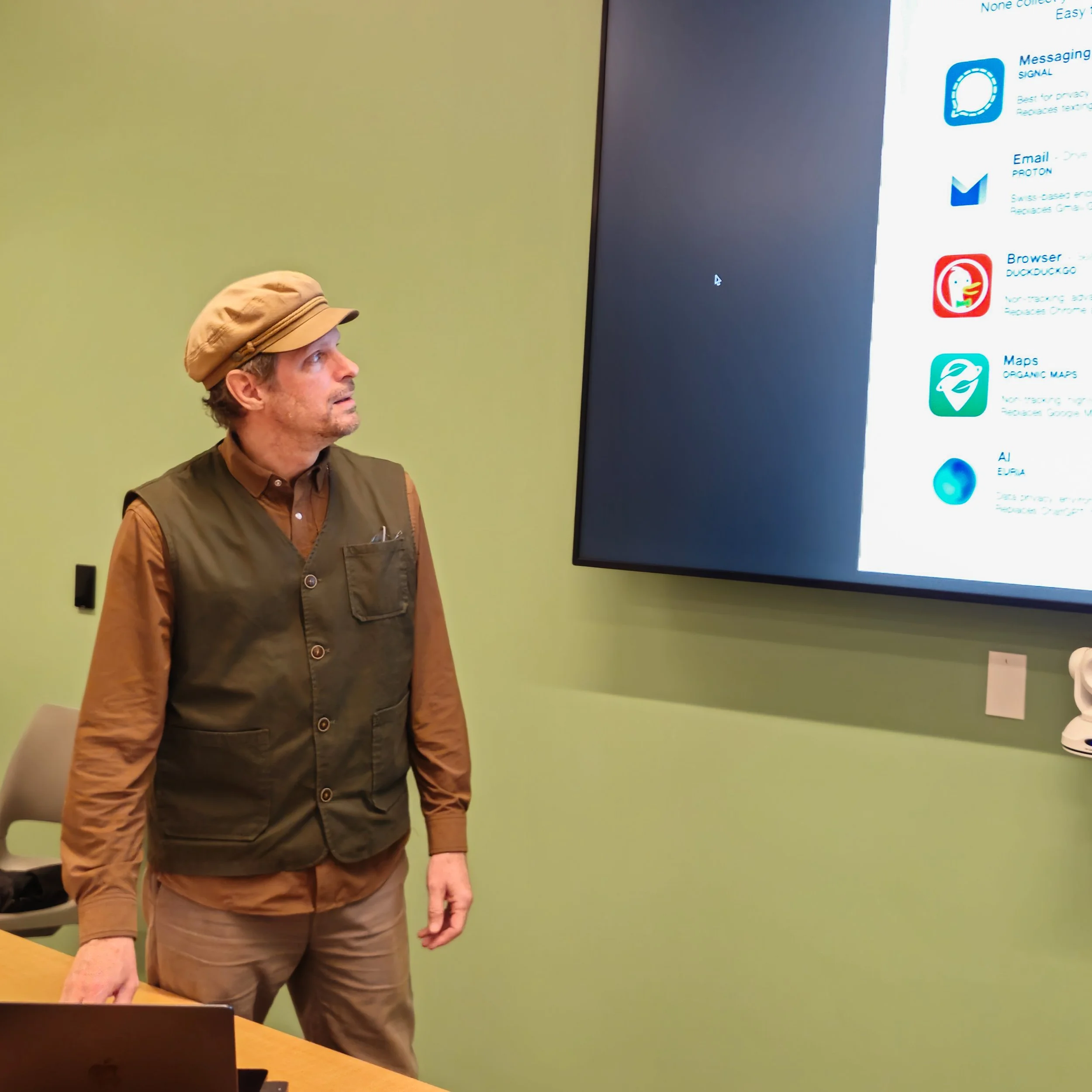
Ethical Tech


Is your favorite app or platform tracking you? Likely so.

Is that just a necessary evil for the conveniences of modern life? No! There are now great ethical-tech options that you will love.

The ones we've gotten used to - like Google, Meta, and Amazon - have created dependency on a surveillance/data-harvesting model largely owned by our billionaire class (increasingly in cahoots with the government). Amazon, for example, wants your data more than it wants to sell you stuff.

Many people realize there’s a problem and would like to change, but don't know where to start. Reclaim control over your data by moving away from invasive platforms to more ethical, privacy-respecting alternatives. It's now easy to switch to greater 'digital sovereignty', let me help. I've done the research so you don't have to.

There are many good choices, my Ethical Tech 'starter kit' of app recommendations mainly covers user-friendly replacements for:

  • Messaging

  • Email

  • Browser/Search

  • Maps

  • AI

Being more intentional in our apps is a crucial stance of resistance in this moment. Few of us will be perfect but we have the power to create a paradigm shift.

Download starter kit PDF here

(note: app names are linked)

More

(last updated 4/4/26)


Who are you, Bill, and why are you talking about this?

I am not an IT expert, I am an artist (photographer and musician) and a long-time arts educator and community organizer. My interest in tech is, in a way, similar to my art stance: what role can it play in empowering us, creating community, and defending ourselves from dark trends? I used to call it ‘resistance tech’. Tech is definitely being weaponized against us, but the right choices can level the playing field and we can weaponize it back.

There are a lot of opinions out there and you will never find the perfect app/platform. My layman’s criteria for ethical tech centers on a balance of:

Data privacy and security - Good protection from surveillance, hacking, and corporate harvesting for ad profiles (especially as the line increasingly blurs between corporate and government profiling).

Environmental impact - Is the company demonstrating commitment to sustainability? Does it use renewable energy and/or offsets? This is especially important for AI.

Integrity of ownership - Is it a billionaire oligarch or a freedom fighter? Is it a massive company profiting from our data and showing disregard for our privacy and rights? Is it a nonprofit? A startup? What do their public statements suggest about their ethics and their vision for the company? I personally left one platform (Substack) based almost solely on public comments by one of its co-founders. Many people once questioned some seemingly loaded political comments by the head of Proton, a company which has been a strong leader for privacy.

Geography of ownership - Is it based in the US or elsewhere, and what jurisdiction is it subject to? The US and Europe have different regulatory landscapes. Swiss law on data protection is different from the EU’s. The question is not just are you protected, but *who* is protecting you.

What is new is that we now have a range of quality choices and can opt out of the deeply embedded surveillance/data-harvesting model of apps and platforms that permeate our lives. Instead of empowering our tech-bro overlords, by making changes we can take back some agency and push the market in the right direction.


Ethical Tech blog

In the news:

Updates:

  • I’m happy to add France’s Mistral AI/Le Chat) to my list of recommendations. I’ve learned more about their good data privacy and about how they’ve been moving in the direction of developing a more environmentally-friendly model. They have a limited free tier and the paid plans start around $15/month, which is comparable to ChatGPT but still far more expensive than Infomaniak’s Euria (Swiss), which is 15 euro per year.

  • I added Soverin as an email option in the ‘More’ document downloadable above. Dutch-based, encryption, no tracking or ads, though only for use with custom email domains.

  • I’m having some doubts about Brave browser, which is included in my secondary recommendations. Mainly from an ownership integrity perspective, which as I said is one of my criteria - I’ve learned Peter Thiel is an investor and the head of Brave has made some concerning past comments. And Brave has always had a crypto element, which is a bit off-putting. Still, it rates highly as a strong privacy browser so keeping on the list for now.


May 6, 2026

Proton and Sustainability

Big news on the 'ethical tech' front: it turns out Proton is in fact using renewable energy. This is key, I knew they were good on privacy but I thought sustainability was not their strong suit.

I use both Proton and Infomaniak's kSuite. Both are Swiss and protected by much better privacy regulations than US tech. I use both because their suites are good at slightly different things. For example, kSuite has Euria, an eco-friendly AI, twice the Drive storage of Proton, and a WeTransfer-type app built in, which is awesome for delivering photos to clients. Infomaniak uses all renewables and even repurposes waste heat from their Geneva data centers, which minimizes water usage. And they are much cheaper than Proton.

For security nothing beats Proton. Now it turns out they are doing more than I thought on sustainable energy, especially important since they have AI as well, called Lumo.

To me data privacy and eco-friendliness should be non-negotiables for your personal tech. Pro tip: Google is not your friend on either count. But now you have two good Swiss options, beyond the clutches of typical US data harvesting and other intrusions.

https://www.devproblems.com/proton-sustainability/


April 11, 2026

Europe has realized it is overly dependent on US tech and is beginning to move to European-hosted solutions. As this blog article from privacy-centric German email provider Tuta explains, that dependence has had real consequences. The chief prosecutor of the International Criminal Court in The Hague had their Microsoft email account blocked at the request of the US administration for political reasons.

What is digital sovereignty – and how Microsoft sparked the trend

In the EU, digital sovereignty is trending. Businesses and authorities are starting to adopt sovereign solutions from Europe


April 6, 2026

Comparing kMeet and Proton Meet, Swiss privacy options

TL;DR version - both are Swiss and therefore protected by Swiss jurisdiction; both use encryption, but Proton by default and kMeet optionally. Both promise to protect your data, the difference being Proton can’t even see it, kMeet can but promises to keep it safe. For either, unless you are an international fugitive, any outside entity asking the companies for your data will be told no and would have to get through a Swiss court to compel any data handover.* With both your data is safe from corporate harvesting and profiling.

[*CORRECTION: After further reading down in the rabbit hole, which is fairly deep, I’ve heard that Proton Meet works great, some claim better than Zoom, with excellent quality and ease of use. But, to get tech-y for a second, I’ve also learned it’s based in part on LiveKit, which is based in the US, for its network. Meaning for the the privacy ultra-conscious, technically LiveKit - not Proton - could be compelled by US authorities to hand over Proton Meet metadata like participant names (not the encrypted meeting content itself, which is safely on Swiss servers) without going through a Swiss court. For the average person this is splitting hairs, not particularly an issue, but for the more hardcore it casts a sliver of doubt on Proton’s privacy street cred, at least for Proton Meet. By contrast, Infomaniak's kMeet is fully hosted on Swiss infrastructure, making it immune to overreach under the US’s CLOUD Act.]

I am a very limited user of AI, I don’t even let it write anything for me, but below I am sharing an edited transcript of what Euria AI told me about kMeet and Proton Meet.

Full disclosure: Euria AI is by Infomaniak, so a bit of favoritism might creep in but seems pretty objective:

Is kMeet private?

Yes, kMeet is designed with privacy as a core principle.

According to Infomaniak's documentation, kMeet is an "ethical" videoconferencing solution that respects privacy by hosting all data exclusively in Switzerland and operating without ads. To ensure your meetings remain private, you can secure them with:

Password Protection: You can set a password when creating a meeting room, which must be shared with participants to allow access.

End-to-End Encryption: For maximum security, you can enable end-to-end encryption using a custom encryption key. This ensures that only participants with the key can access the meeting content.

These features, combined with Infomaniak's ISO 27001 certification and Swiss-based infrastructure, make kMeet a private alternative to other video conferencing tools.

Proton just rolled out their version of Meet. How do they compare?

Proton has indeed just launched Proton Meet (around April 1, 2026), positioning it as a privacy-first alternative to Google Meet, Zoom, and Microsoft Teams. Here is how it compares to Infomaniak kMeet:

Core Similarities

  • Privacy-First Philosophy: Both services are built by European companies (Switzerland) with a strong commitment to privacy, no ads, and no tracking.

  • End-to-End Encryption (E2EE): Both offer end-to-end encryption to ensure that only participants can access the meeting content.

  • No Account Required for Guests: Both allow users to join meetings without creating an account.

  • Swiss Hosting: Both host their data exclusively in Switzerland, benefiting from strong Swiss privacy laws.

Key Differences

Encryption Protocol:

  • Proton Meet (new 2026) - Uses encryption by default for all calls. Their newer, open standard is designed for group messaging and conferencing, offering "forward secrecy" (new members can't read past messages) and "post-compromise security."

  • Infomaniak kMeet - E2EE is available as an option that the host must enable (via a password or custom encryption key).

Anonymity

  • Proton Meet - Participant names are encrypted end-to-end. Email addresses and IP addresses are not shared between participants. Proton does not keep logs of attendance.

  • kMeet - Focuses on securing the content of the meeting. Participant identity is managed by the host (e.g., waiting room, password), but the protocol for encrypting participant metadata (like names) is less emphasized than in Proton

Ecosystem

  • Proton Meet - Part of the new Proton Workspace, integrating tightly with Proton Mail, Calendar, and Drive. Aims to be a full Google Workspace/Microsoft 365 alternative.

  • kMeet - Part of the kSuite, integrating with kMail, kDrive, kChat, and Calendar. Also offers a complete suite for collaboration.

Summary

Choose Proton Meet if: You want the absolute latest in encryption standards (MLS) by default, prioritize metadata privacy (encrypted participant names), and are already invested in the Proton ecosystem (Mail, VPN, Drive). It is ideal for journalists, activists, or anyone needing maximum anonymity.

Choose Infomaniak kMeet if: You need a mature, feature-rich platform with established tools like breakout rooms, recording, and remote control. It is an excellent choice for businesses and educators already using kSuite who want a reliable, ethical, and Swiss-hosted solution with robust moderation tools.

Both are excellent privacy-focused choices, but Proton Meet pushes the envelope on default encryption and metadata protection, while kMeet offers a more comprehensive set of collaboration features built on a proven platform.

Would it be fair to say that Infomaniak technically can see your metadata (participant names, etc) but we are *trusting* that under Swiss law and with their Swiss servers that all will remain private? Of course the conversation itself can be encrypted.

That is a very fair and technically accurate assessment of the current architectural difference between the two services, specifically regarding how they handle metadata by default.

Proton has engineered a system where the server technically cannot decrypt participant names, messages, or media streams. The encryption keys are generated and held only on the clients' devices.

Unlike US companies (subject to the CLOUD Act) or EU companies (subject to certain intelligence-sharing agreements), Swiss companies have strong legal shields against foreign government data requests. Infomaniak is independent, employee-owned, and explicitly states in its charter that it does not sell data or profile users. Their business model is subscription-based, not data-based.

Infomaniak and Proton are bound by the Swiss Federal Act on Data Protection, which is among the strictest in the world.

Conclusion

You hit the nail on the head:

  • Proton sells mathematical guarantees (Zero-Knowledge).

  • Infomaniak sells jurisdictional guarantees (Swiss Sovereignty + Ethics).

Neither is inherently "better"; it depends on your threat model. If your adversary is a nation-state that can compel a company to install a backdoor, Proton is safer. If your adversary is data harvesting, corporate profiling, or foreign legal overreach (like the US CLOUD Act), Infomaniak provides robust protection with significantly better usability and collaboration features.


April 4, 2026

On Encryption

As I type this, encryption itself is under siege, even in Europe. Many EU countries - including, surprisingly, the likes of Sweden and France - have been trying to pass laws, mostly unsuccessfully so far, to weaken or eliminate encryption for individuals in favor of broader law enforcement needs against criminal activity. Often it is framed as encryption but with a ‘back door’ for law enforcement to snoop. Other countries, like Germany, have been standing firm for the right to truly private digital communications. Encryption-based services like Signal and Proton have threatened to pull out of the market of any country that undermines encryption.

We will see how that plays out, though I should note that European services are governed by much stricter privacy rules than the US, and there is currently a movement in Europe to extricate from US Big Tech due to the potential for US government and corporate overreach.