My Ethical Tech workshops at the local library went well the last two weeks. Though coming out of my second one I had a touch of actual vertigo, which was not fun but somehow apropos.
Even relatively tech-savvy people seem to understand there’s a problem but don’t quite have their heads around what they should do about it.
Yeah, I know, I’ve been beating this drum for a while but reclaiming our digital sovereignty is becoming more urgent, not less. At the risk of repeating myself, of being redundant, of saying the same thing over and over… (ok sorry, it’s a old Fraser line from Cheers ;), let’s go over this again for those in the back row.
The problem? Tech companies are basically spying on us. I don’t know what else to call it. Tracking us. Compiling that info with other info into profiles of us. Making money from selling that info. Cooperating with government requests for that info, or at best not securing it properly from hacking. All those AI prompts? Not secure. We shouldn’t be putting anything sensitive into AI.
I don’t think anyone really knows the full extent of what’s going on. The trail of our data online is long and opaque. The dovetailing of government and corporate surveillance interests is getting scary, and even to a casual observer is clearly in concert with the goals of the right-wing project overall (though data harvesting and tracking predates the current regime by many years).
I’m actually putting things mildly, trying to keep it breezy so I don’t sound a little too bug-eyed.
But I read recently that Google, Meta et al have received literally millions of data requests from the government in recent years, so it’s not an academic concern. According to this post, from the reputable German privacy-email provider Tuta, Microsoft was willing to shut down the email of the International Criminal Court’s chief prosecutor at the behest of the US authorities, throwing the ICC into turmoil.
If data is the battlefield, choosing more privacy-centric apps is one of the most important things we can all do right now. Data they don’t have can’t be misused, surveilled, sold, or stolen.
“Well, I’m not doing anything wrong, so what do I care, I need the convenience.”
Trust me, that’s very ten-years-ago thinking, when we thought tech companies would do no evil. Our addiction is actually to convenience. It’s time to start being more intentional in our digital choices. Anyway, now we can have the convenience without the risk.
“I can’t, we use Google at work.”
So choose something else for your personal use.
What criteria constitutes an app or platform being ‘ethical’, or better aligned with your values? As I talked about in my workshops (and describe in more detail on my new Ethical Tech page if you’re interested), it’s a question of:
Data privacy and security - First and foremost, good protection from surveillance, hacking, and corporate harvesting for ad profiles (especially as the line increasingly blurs between corporate and government profiling).
Environmental impact - Is the company demonstrating commitment to sustainability? Does it use renewable energy? This is especially important for AI.
Integrity of ownership - Is the owner a billionaire oligarch, or a freedom fighter? Is it a massive company profiting from our data and showing disregard for our privacy and rights? Is it a nonprofit? A plucky startup? What do their public statements suggest about their ethics and their vision for the company? I personally left one platform (Substack) based almost solely on public comments by one of its co-founders. Even vaunted privacy-centric Proton has fallen under suspicion in the past after some political comments by its head.
Geography of ownership - What jurisdiction is it subject to? The US and Europe have different regulatory landscapes, in the US your data is far more vulnerable. Switzerland is not a total digital bastion by any means but some consider the Swiss to have even stronger shielding from foreign data requests than the EU. Such requests would have to go through a Swiss court, which would likely say no unless you are an actual fugitive. And no one is able to harvest your Proton data for ad profiling.
Geography is indeed important. Any information on or passing through US-based servers can be demanded by the US government. American tech companies’ servers based abroad are also subject to intrusion. At the moment the best protection, even for the average person, is European apps actually physically based in Europe. Europeans have arrived at the same conclusion, there’s a movement afoot to get off US tech entirely.
The exceptions would be smaller, non-bro US companies with a demonstrated independent, privacy-minded stance like Signal or DuckDuckGo. They are relatively immune to prying entities - because they don’t have your data, and what they have (encrypted Signal chats) they couldn’t read if they wanted to.
So what should you do? I realize most people don’t want to think too much about this stuff - unlike me, waving hi from deep in the rabbit hole.
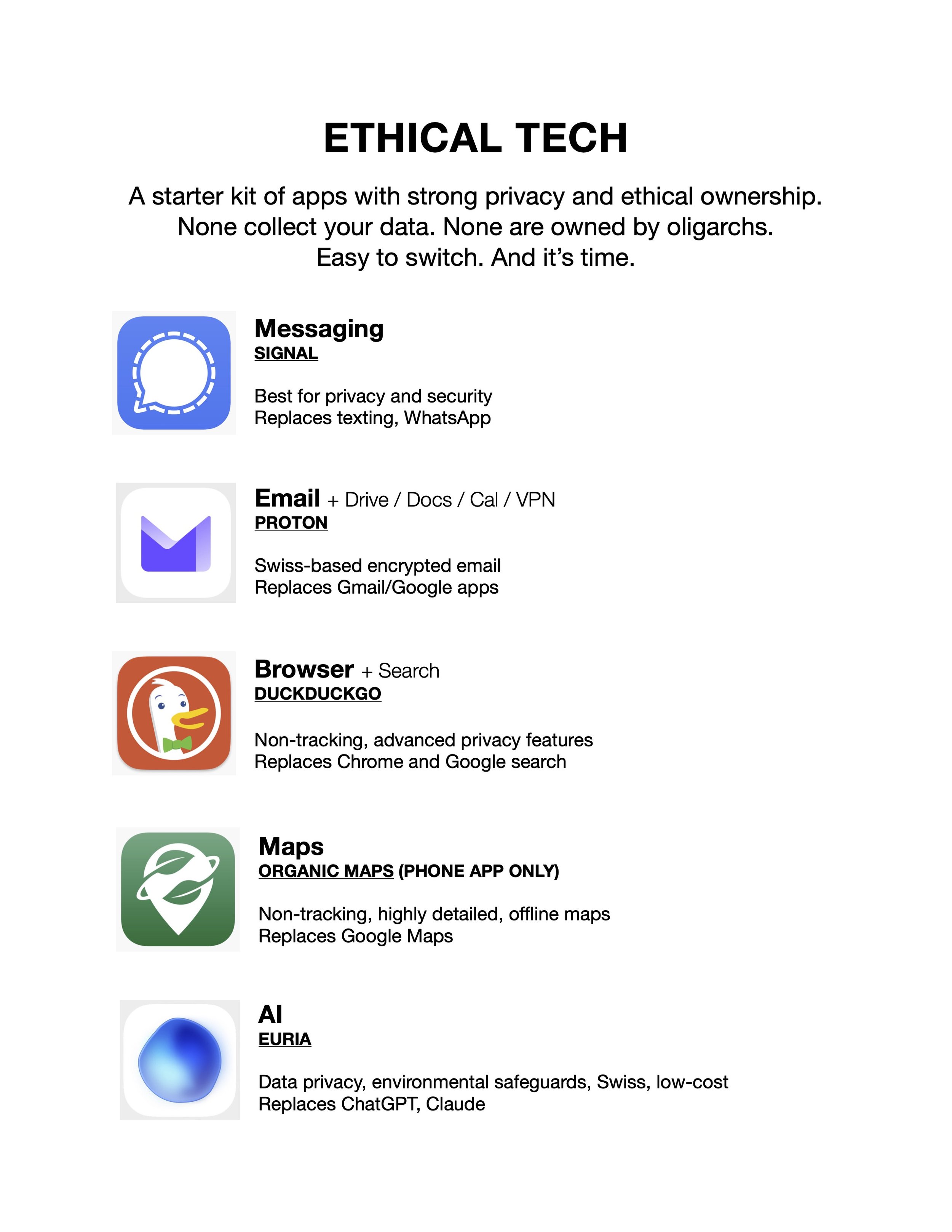
If I had to choose one app for each of our most basic daily tech needs, that balance the above criteria and are easiest to switch to, here they are again below.
None are perfect but all are excellent, user-friendly choices that will quickly and greatly shift your app landscape toward digital sovereignty. You can always just start using them and sundown the old ones gradually if needed.
Signal is still the gold standard for encrypted messaging. WhatsApp is encrypted too but sells your valuable metadata (like your name and who you wrote to and when), Signal doesn’t take it to begin with. More of your friends are probably there than you think. The head of Signal, Meredith Whittaker, is a bad-ass warrior for protecting your data. It’s US-based but a nonprofit. Clearly the government uses Signal too, so they can’t afford to undermine it.
There really are no other good options. Well, there are but no one is there. It’s Signal or WhatsApp. Telegram is not secure and the owner is sus. You don’t have to give up WhatsApp necessarily, I use both since so many people especially internationally are on it. In Kenya it was a must-have.
Proton is still the top choice for encrypted email and an app suite that can more or less replace Google Workspace, plus a good VPN and password manager, with the protection of both encryption and Swiss privacy laws. Now including a brand new Zoom alternative, Proton Meet. Keep in mind emails are not automatically encrypted unless sending from Proton to someone else with Proton. Otherwise it sends and receives normally unless you optionally encrypt the message with a password, which you send separately. It’s pretty simple, I use that for things like sending docs to our tax accountant.
DuckDuckGo is US-based but a ‘good guy’, so far it hasn’t had issues with government overreach. An easy switch to one of the best privacy browsers and search engines, not just not tracking you but stopping others from doing so as you cruise the web. By contrast, Google tracks you even when you’re not using Google products. DDG’s search engine is good and the paid tier has a VPN and some other goodies like email protection.
Organic Maps is free, non-tracking, no ads, open source, and uses downloaded maps that you can use without wifi or phone signal. The interface takes a few minutes to figure out but then you’re good to go. Google Maps works great, yeah, but it tracks the hell out of you. This one is pure integrity and worked great for me in Kenya, Europe, and the US. It’s awesome and very detailed for off-road navigation like hiking.
Euria is your Swiss-based choice if you do use AI, which I am not advocating (for all kinds of reasons). Features both strong data privacy and environmental protection. They use renewable energy AND repurpose waste heat for heating local homes, so water use is minimal. No one else does this. A few like Duck AI and Proton’s Lumo offer good privacy but zero green credentials [Correction: turns out Proton does use renewable energy in addition to its excellent data privacy]. Euria has a very Swiss ‘personality’ - friendly and helpful but efficient, without the overly kiss-ass fluff. Minimal hallucinations, though they all get things wrong sometimes as you know. A friend who switched from ChatGPT for analyzing work documents is very happy with Euria.
You can also download this list as a PDF with links here.