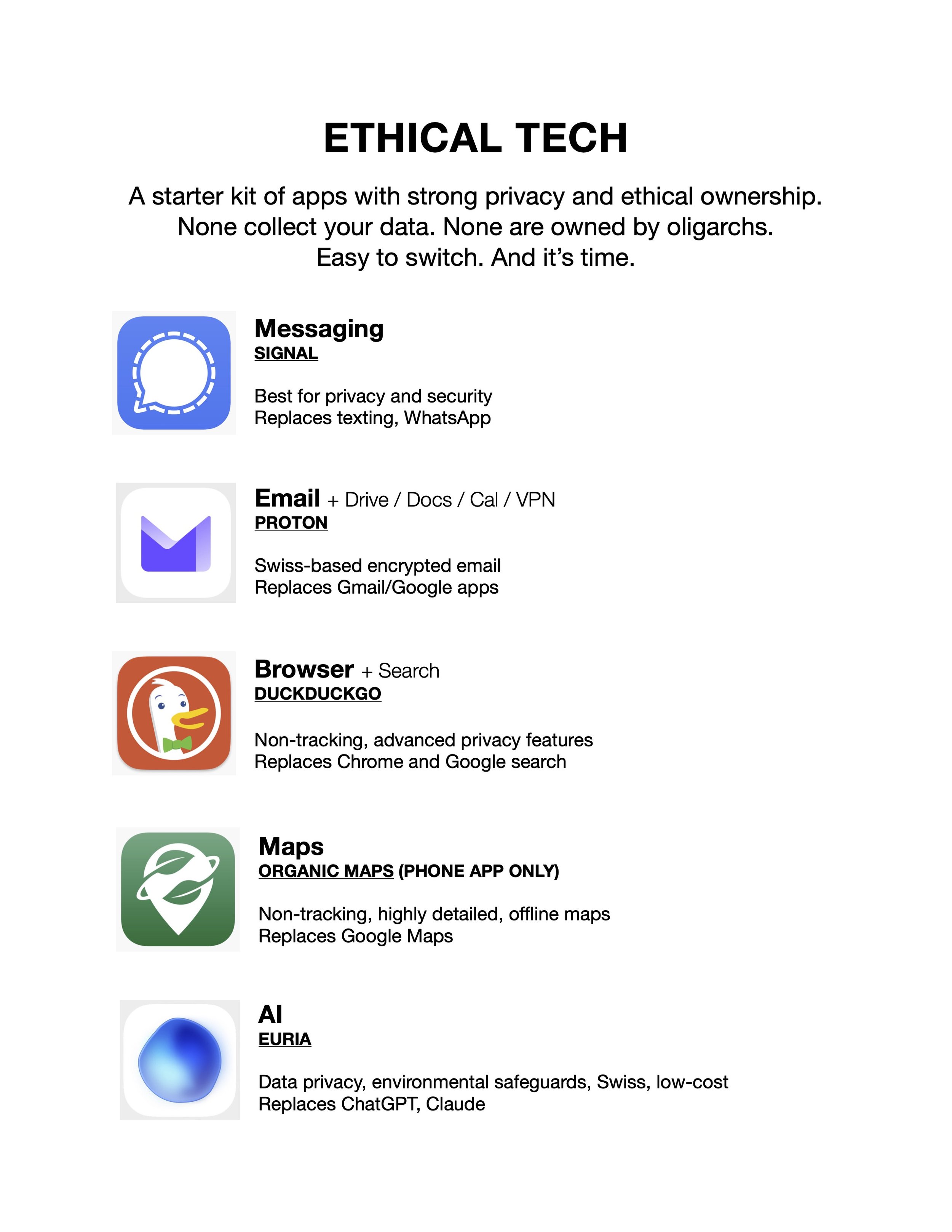
Latest roundup of apps and platforms if you’re looking for ‘cozier’ options with more integrity and privacy (and less ick) than tech-bro/surveillance-capitalism models.
I’m not anti-tech, just want us to make better choices when we have them.

Cantilever
Phone-only at the moment, this is the first app in a while that feels like a welcome and hopeful innovation for music. The big streaming services have been key villains in music’s devaluation. Yes, anything-for-free-all-the-time is nice for the listener but the basic equation for artists is they have traded actual sales of their music for a pitiful slice of the streaming pie.
The way Cantilever works is both simple and fairly wonderful. For six bucks a month (worth it, imo, and it goes to the artists you actually listen to) they recommend 15 albums at a time, each on the feed for 30 days. New ones are cycled in and older ones cycled out on a staggered basis. Each album has a thoughtful writeup to read while you listen, which is somewhat like the old days of looking at album art, lyrics, etc as the record played.
I haven’t done a deep dive into the money equation. But I saw that with 10,000 listeners, an album on Cantilever could earn for the artist the equivalent of over 1 million Spotify streams.
Yes, Cantilever is a boutique approach and no, they might not align perfectly with your existing tastes. But it’s a pretty diverse cross-section - and not just new albums. So far I’ve liked a good chunk of the offerings, even ones not usually in my wheelhouse. Personally I enjoy music shopping from a well-curated batch instead of the endless, deadening options of the major platforms. And the format does encourage listening to the whole album as it was authored. How refreshing.
Cantilever is sort of a throwback to the music magazines of old like NME and Melody Maker. You counted on them for discovery. If you didn’t like who they pushed, you read a different magazine. Maybe if Cantilever does well it will bring a variety of competitors to serve as the new music magazines.

Curb
I hadn’t given much thought to Uber on the ethical-tech front. I suspect you haven’t either, it’s a go-to app that most people don’t think twice about. Nonetheless, I just looked into it and turns out it’s a terrible choice. If you can avoid it, do.
It’s basically as bad as Google - harvesting everything it can to compile profiles of you across its services - plus that surge pricing and dodgy ownership (BlackRock and Vanguard). It’s a surveillance, gig-economy model. No, Lyft is not much better.
Uber and Lyft both use "surveillance pricing," adjusting fares based on your device type, battery level, location history, and perceived urgency. Curb uses regulated meters or transparent flat rates, so the fare is determined by distance and time, not your personal data profile.
The only data it collects is to facilitate you getting a taxi. No price surges. Taxi drivers are more regulated and background-checked than Uber drivers.
I haven’t tried it yet but I plan to. Curb sounds like a great addition to the ethical-tech toolkit. Uber could be minimized but still work as a fallback option. I mean, you don’t have to strand yourself for ethical street cred.

Kagi
Kagi is an interesting and growing ecosystem.
From their About page:
At Kagi, we envision a friendly internet where you can explore, learn, and interact with confidence and ease. Our mission is to humanize the web, making it more accessible, and centered around your needs. We're driven by our core purpose: to inform and educate, empowering you with knowledge and understanding in your digital journey. Every product we build reflects this commitment, designed without ads, trackers, or distractions, and completely free from surveillance.
Maybe the most intriguing part of their suite is Kagi Small Web (which has its own app), elevating a nice roundup of over 30,000 quirky, human blogs. Part of what has also been called the ‘cozy web’.
Notice at the top there’s a button for all the different topics/categories. One way to browse a cross-section is the ‘Liked’ tab.
They also have a privacy-focused (paid) search engine. Haven’t tried it.

Euria
With the latest news of our possible impending demise at the hands of scheming agentic AI, I would be remiss to not give my regular reminder that there is an ethical-tech alternative to the US Big AI models.
Swiss-based Euria works well as an assistant (a ‘bright Swiss intern’) with proper guardrails. Your data is not harvested for any reason, it’s kept secure and private on their Swiss servers. This matters because anything on US servers can be requested by the government. Euria also takes care of the environmental impact of AI by using renewable energy and repurposing waste heat (which minimizes water usage to almost zero).
No, it’s not generative, it won’t make your band flyer. But you shouldn’t be doing that anyway.
I don’t let it write for me but I’ll let it speak for itself. If you use AI, I think you’ll find it a reassuring and attractive option:
With new reports of experts' fears of runaway AI taking over and killing humanity, how would you say Euria is positioned against those dark trends?
While some experts fear autonomous AI systems acquiring unchecked capabilities or acting against human interests, Euria operates under strict in-memory processing only, meaning it retains no data between sessions and cannot accumulate power, memory, or autonomous agency over time. It is hosted entirely in Swiss data centers powered by renewable energy, adhering to principles of neutrality, non-discrimination, and privacy.
Euria has no ability to act independently: it cannot execute code, access external systems, modify its own instructions, or interact with applications directly. It functions solely as a responsive assistant that analyzes documents, drafts content, and retrieves information only when explicitly triggered by user queries.
Furthermore, Euria is bound by ethical guardrails that prevent it from generating hate speech, inciting violence, or engaging in defamation. It is programmed to refuse executing illegal activities and to flag sensitive data appropriately. Unlike theoretical runaway AI scenarios where systems optimize for goals misaligned with human values, Euria has no goals of its own—its only purpose is to assist users within strictly defined boundaries.
Euria represents a model of responsible AI: powerful enough to be useful, but constrained by design to remain a tool under human control, transparent in its operations, and incapable of the self-preservation or goal-seeking behaviors that fuel existential fears.