Digital Sovereignty

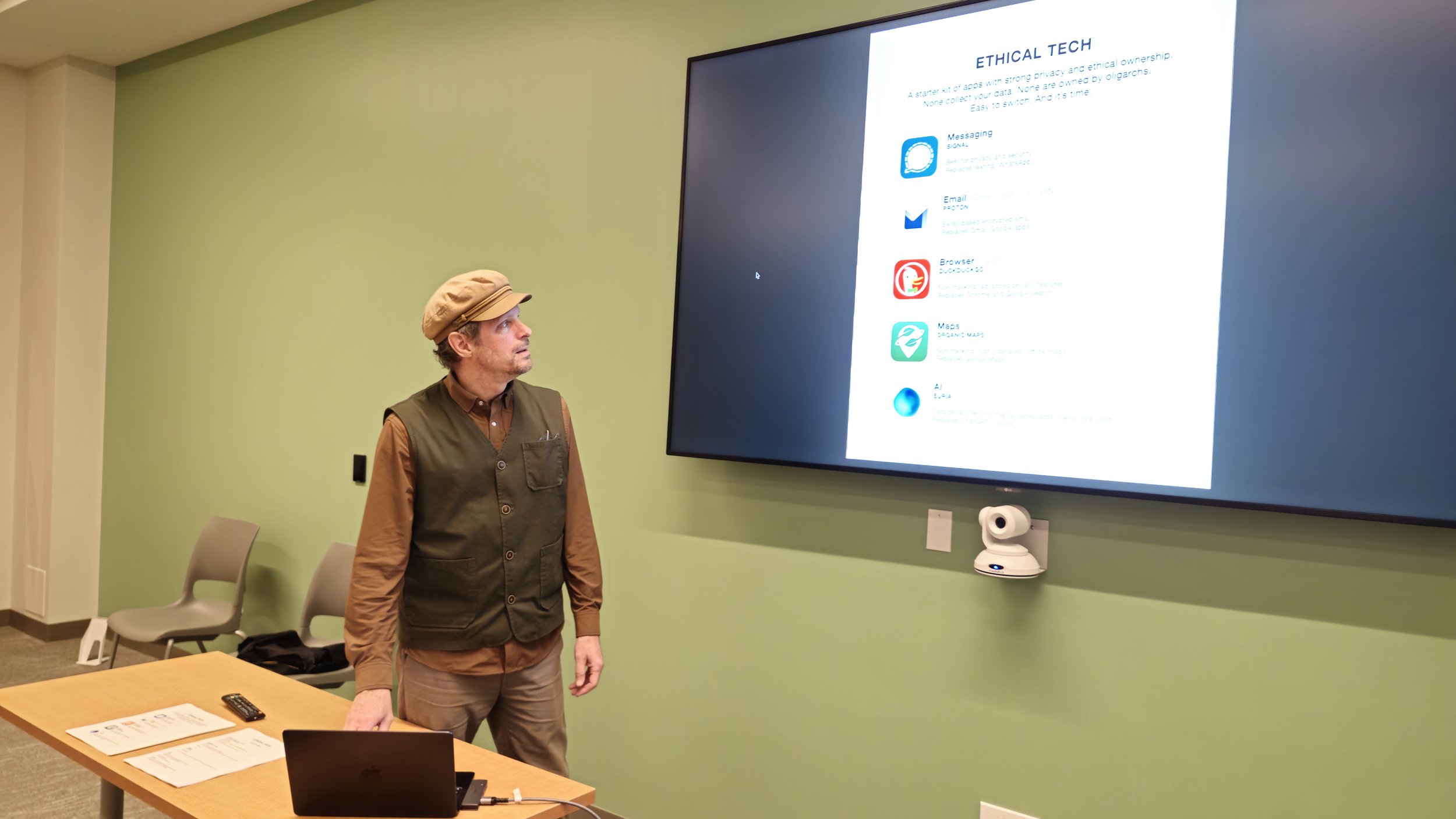
My Ethical Tech workshops at the local library went well the last two weeks. Though coming out of my second one I had a touch of actual vertigo, which was not fun but somehow apropos.

Even relatively tech-savvy people seem to understand there’s a problem but don’t quite have their heads around what they should do about it.

Yeah, I know, I’ve been beating this drum for a while but reclaiming our digital sovereignty is becoming more urgent, not less. At the risk of repeating myself, of being redundant, of saying the same thing over and over… (ok sorry, it’s a old Fraser line from Cheers ;), let’s go over this again for those in the back row.

The problem? Tech companies are basically spying on us. I don’t know what else to call it. Tracking us. Compiling that info with other info into profiles of us. Making money from selling that info. Cooperating with government requests for that info, or at best not securing it properly from hacking. All those AI prompts? Not secure. We shouldn’t be putting anything sensitive into AI.

I don’t think anyone really knows the full extent of what’s going on. The trail of our data online is long and opaque. The dovetailing of government and corporate surveillance interests is getting scary, and even to a casual observer is clearly in concert with the goals of the right-wing project overall (though data harvesting and tracking predates the current regime by many years).

I’m actually putting things mildly, trying to keep it breezy so I don’t sound a little too bug-eyed.

But I read recently that Google, Meta et al have received literally millions of data requests from the government in recent years, so it’s not an academic concern. According to this post, from the reputable German privacy-email provider Tuta, Microsoft was willing to shut down the email of the International Criminal Court’s chief prosecutor at the behest of the US authorities, throwing the ICC into turmoil.


If data is the battlefield, choosing more privacy-centric apps is one of the most important things we can all do right now. Data they don’t have can’t be misused, surveilled, sold, or stolen.

“Well, I’m not doing anything wrong, so what do I care, I need the convenience.”

Trust me, that’s very ten-years-ago thinking, when we thought tech companies would do no evil. Our addiction is actually to convenience. It’s time to start being more intentional in our digital choices. Anyway, now we can have the convenience without the risk.

“I can’t, we use Google at work.”

So choose something else for your personal use.

What criteria constitutes an app or platform being ‘ethical’, or better aligned with your values? As I talked about in my workshops (and describe in more detail on my new Ethical Tech page if you’re interested), it’s a question of:

  • Data privacy and security - First and foremost, good protection from surveillance, hacking, and corporate harvesting for ad profiles (especially as the line increasingly blurs between corporate and government profiling).

  • Environmental impact - Is the company demonstrating commitment to sustainability? Does it use renewable energy? This is especially important for AI.

  • Integrity of ownership - Is the owner a billionaire oligarch, or a freedom fighter? Is it a massive company profiting from our data and showing disregard for our privacy and rights? Is it a nonprofit? A plucky startup? What do their public statements suggest about their ethics and their vision for the company? I personally left one platform (Substack) based almost solely on public comments by one of its co-founders. Even vaunted privacy-centric Proton has fallen under suspicion in the past after some political comments by its head.

  • Geography of ownership - What jurisdiction is it subject to? The US and Europe have different regulatory landscapes, in the US your data is far more vulnerable. Switzerland is not a total digital bastion by any means but some consider the Swiss to have even stronger shielding from foreign data requests than the EU. Such requests would have to go through a Swiss court, which would likely say no unless you are an actual fugitive. And no one is able to harvest your Proton data for ad profiling.

Geography is indeed important. Any information on or passing through US-based servers can be demanded by the US government. American tech companies’ servers based abroad are also subject to intrusion. At the moment the best protection, even for the average person, is European apps actually physically based in Europe. Europeans have arrived at the same conclusion, there’s a movement afoot to get off US tech entirely.

The exceptions would be smaller, non-bro US companies with a demonstrated independent, privacy-minded stance like Signal or DuckDuckGo. They are relatively immune to prying entities - because they don’t have your data, and what they have (encrypted Signal chats) they couldn’t read if they wanted to.


So what should you do? I realize most people don’t want to think too much about this stuff - unlike me, waving hi from deep in the rabbit hole.

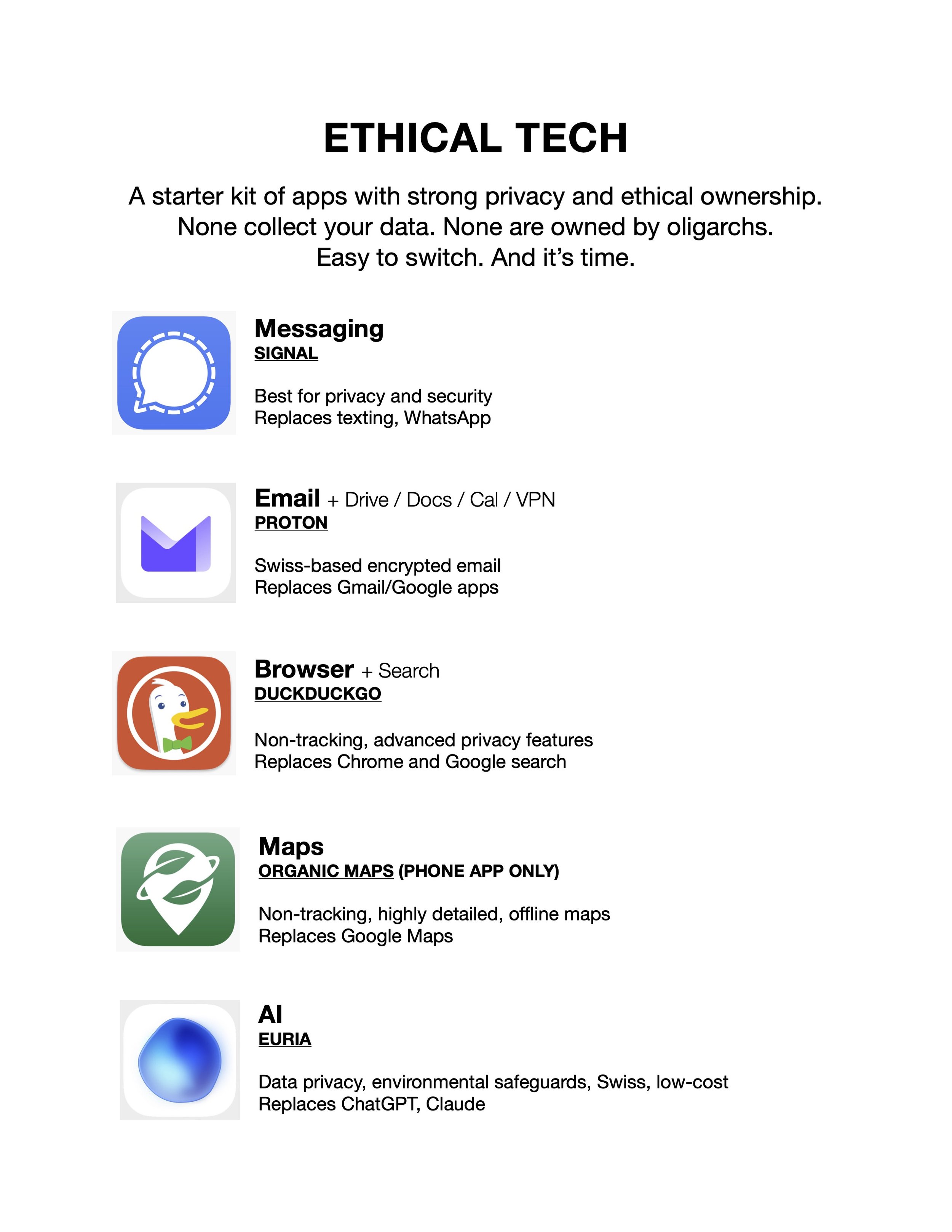
If I had to choose one app for each of our most basic daily tech needs, that balance the above criteria and are easiest to switch to, here they are again below.

None are perfect but all are excellent, user-friendly choices that will quickly and greatly shift your app landscape toward digital sovereignty. You can always just start using them and sundown the old ones gradually if needed.

  • Signal is still the gold standard for encrypted messaging. WhatsApp is encrypted too but sells your valuable metadata (like your name and who you wrote to and when), Signal doesn’t take it to begin with. More of your friends are probably there than you think. The head of Signal, Meredith Whittaker, is a bad-ass warrior for protecting your data. It’s US-based but a nonprofit. Clearly the government uses Signal too, so they can’t afford to undermine it.

    There really are no other good options. Well, there are but no one is there. It’s Signal or WhatsApp. Telegram is not secure and the owner is sus. You don’t have to give up WhatsApp necessarily, I use both since so many people especially internationally are on it. In Kenya it was a must-have.

  • Proton is still the top choice for encrypted email and an app suite that can more or less replace Google Workspace, plus a good VPN and password manager, with the protection of both encryption and Swiss privacy laws. Now including a brand new Zoom alternative, Proton Meet. Keep in mind emails are not automatically encrypted unless sending from Proton to someone else with Proton. Otherwise it sends and receives normally unless you optionally encrypt the message with a password, which you send separately. It’s pretty simple, I use that for things like sending docs to our tax accountant.

  • DuckDuckGo is US-based but a ‘good guy’, so far it hasn’t had issues with government overreach. An easy switch to one of the best privacy browsers and search engines, not just not tracking you but stopping others from doing so as you cruise the web. By contrast, Google tracks you even when you’re not using Google products. DDG’s search engine is good and the paid tier has a VPN and some other goodies like email protection.

  • Organic Maps is free, non-tracking, no ads, open source, and uses downloaded maps that you can use without wifi or phone signal. The interface takes a few minutes to figure out but then you’re good to go. Google Maps works great, yeah, but it tracks the hell out of you. This one is pure integrity and worked great for me in Kenya, Europe, and the US. It’s awesome and very detailed for off-road navigation like hiking.

  • Euria is your Swiss-based choice if you do use AI, which I am not advocating (for all kinds of reasons). Features both strong data privacy and environmental protection. They use renewable energy AND repurpose waste heat for heating local homes, so water use is minimal. No one else does this. A few like Duck AI and Proton’s Lumo offer good privacy but zero green credentials [Correction: turns out Proton does use renewable energy in addition to its excellent data privacy]. Euria has a very Swiss ‘personality’ - friendly and helpful but efficient, without the overly kiss-ass fluff. Minimal hallucinations, though they all get things wrong sometimes as you know. A friend who switched from ChatGPT for analyzing work documents is very happy with Euria.

You can also download this list as a PDF with links here.

The Tumblr Edition

Greetings from Nairobi.

If asked, I don’t really know how to describe what I generally post about. Sometimes it’s personal musings or updates, sometimes on photography in various ways, sometimes my music endeavors and various resistance-tech fixations. All are me trying to process life and ideas and share it out in ways that are hopefully interesting, relevant, and that respect your intelligence. To me, all have an undertow of mindful, art-based resistance, even if it’s not explicit.

Who knows if I’m doing it ‘right’? Maybe I should stay more focused. Or, maybe I need to mix it up more.

How would it look if I collected a couple weeks worth of stuff I’d normally post on social media and put it here? (That’s sort of what I was doing with my former Viaduct Arts newsletter, for those that subscribed to that. Viaduct was usually a compilation/digest of recent FB posts with a note from me at the top.)

What if you didn’t have to doomscroll on whatever platform to come across each individual post randomly, instead it all plopped as a bundle into your email on a Sunday morning?

It’s not a perfect experiment. Images seem to work best. I’m already discovering what wouldn’t work well in this space, like links, reels, anything not ‘evergreen’ enough to last more than a day. And of course it means you can’t comment or like the individual items.

There’s not as much to choose from since I like many others don’t post that much anymore, though FB is one of the few places I do. I barely look at Instagram, though it’s the only way to keep up with my Kenyan photographer friends. I dipped back into Threads the other day and it’s still way livelier discourse than Bluesky, which to my chagrin I’m beginning to give up on but I’ll leave that for another post.

In general I think the model of sharing broadly with strangers may be nearing a close. If there was a better way to share with friends and family that didn’t require wading through FB’s dreary AI slop or IG’s reels I’d sign up in a second. Otherwise I’m feeling a bit done. Anyone feel the same?

I’m more interested these days in what I’ve heard called the ‘cozy web’ - newsletters, groups, blogs. I’m liking good ol’ email, highly recommend Proton for the encryption. I’ve tried leaning into corresponding more substantively with a few friends via Signal, it’s been good. We’re so used to messaging being for quick hits, why not think of it like writing a more thoughtful letter or postcard?

Of course, I think many people are starting to remember that nothing beats in-person, real life interaction. And that might just be what saves us.

While on the subject of platforms, this is required reading about Substack. While it’s a place for valuable and interesting independent voices, it’s also a Nazi bar of sorts, comfortable enabling various creepy-crawlies:

Substack’s extremist ecosystem is flourishing


How about more Tumblr-style? Just throw things out there. I know times are dire but maybe we are feeding the beast by focusing on it to the exclusion of all else. There has to be more to life than Wordle results and end-times fascism (aka ‘political’) news. Which I guess eliminates much of what I (and probably you) post on FB. Let me see what else I got.

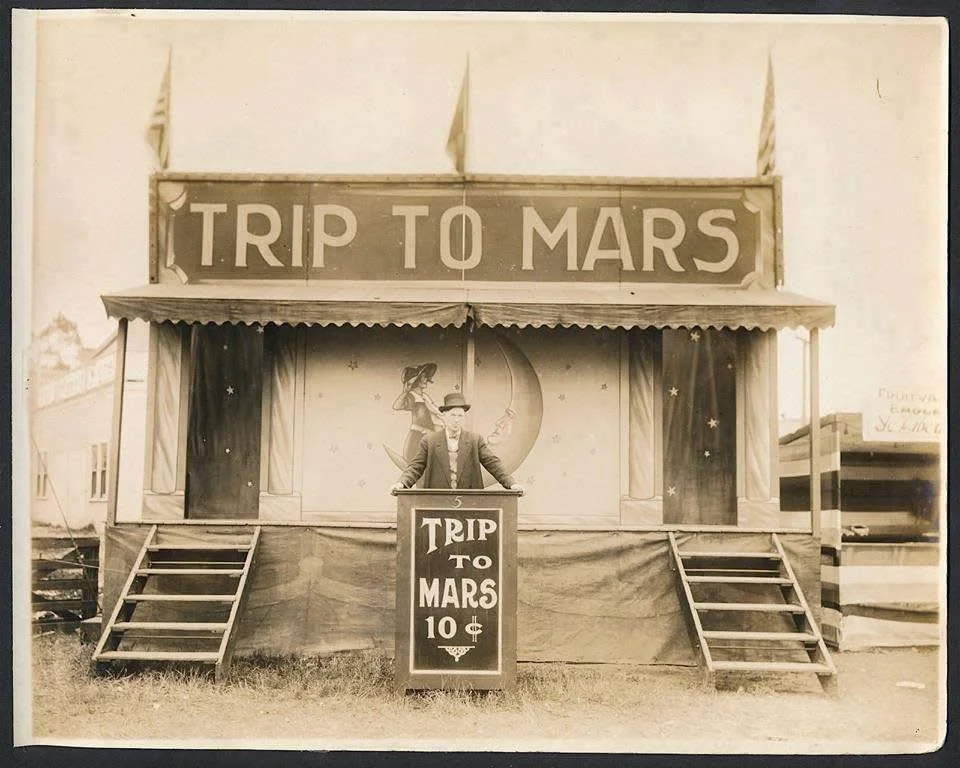
A better idea than the real thing, though there are certain people I wouldn’t mind being flung into actual space.

Remember magazines? The late Stockholm New was an amazing once-yearly (!) culture/art/fashion mag that I used to collect in the before-times. Didn’t know there was a ‘best of’ book. (Though I’ll admit that cover image sure lands more toxically these days…)

It had beautiful minimalist design that I used in my Publication Design class. I sent it recently as inspo to a Kenyan friend who I’m helping develop a Nairobi art magazine.

I think mags like Kinfolk and Cereal were pretty heavily influenced by Stockholm New.


I’m onboard with ‘clanker’ as a slur for robots and AI.

Cool micro art shop in Haworth, England. All work by the artist-owner (no I didn’t take this pic, just came across it).

Samples from my World Landscapes print gallery.


Wet Leg. Hell of a band (and band name). New album Moisturizer is the finest rock record I’ve heard in a while.

I had been reading good things about Superman. Ok, I saw it in French, which didn’t help. A lot I didn’t like but mainly methinks the director took the ‘let’s up the stakes by making him vulnerable’ thing too far. He spends the whole movie getting his ass kicked or crawling out from under the big thing that landed on him.

"Personally I am very pessimistic. But when, for instance, one of my staff has a baby you can't help but bless them for a good future. Because I can't tell that child, 'Oh, you shouldn't have come into this life.' And yet I know the world is heading in a bad direction. So with those conflicting thoughts in mind, I think about what kind of films I should be making." - Hayao Miyazaki


This just in before I hit publish today, I’ll leave you with Robert Reich’s thoughts on Vaclav Havel and not letting the times suffocate us:

Havel had become politically active as poet, playwright, and dissident after the Warsaw Pact invasion of Czechoslovakia in 1968 — which put him under the surveillance of the secret police. He was repeatedly jailed, the longest from 1979 to 1983. (In 1989, his Civic Forum party played a major part in the Velvet Revolution that ended Soviet dominance, and he was elected president shortly thereafter.)

While in jail, Havel wrote something that seems particularly relevant for us in these very dark times:

“The kind of hope I often think about (especially in situations that are particularly hopeless, such as prison) I understand above all as a state of mind, not a state of the world. Either we have hope within us or we don’t; it is a dimension of the soul; it’s not essentially dependent on some particular observation of the world or estimate of the situation.

Hope is a not prognostication. It is an orientation of the spirit, an orientation of the heart; it transcends the world that is immediately experienced, and is anchored somewhere beyond its horizons. Hope, in this deep and powerful sense, is not the same as joy that things are going well, or willingness to invest in enterprises that are obviously headed for early success, but, rather, an ability to work for something because it is good, not just because it stands a chance to succeed.”

RSS is back (did it ever leave?)

I have to say I’m really liking using RSS again. I’m using the Feeder app, which is free and not hard to figure out how to use. It’s great for following independent news/info voices in one place. For me that’s rock stars like Rebecca Solnit, Heather Cox Richardson, Anne Applebaum, Jessica Berlin, Marisa Kabas, Alt National Park Service, and many others.

What I’d love to move towards over time is using this blog as social media. I’m already doing a post-here-first strategy, at least for my writing and photos, but maybe need to consider more social-type posts (like this) as well.

That way if you want to follow Bill, you come here. And bye bye Meta.