

Wow, a blast from the past from my photographer friend Karel Cudlin. That’s me in booth 9. Karel and I had an exhibit together in Minsk on the afternoon of 9/11. At the opening the Czech cultural attaché was the first to tell me what was happening at home (some friends said they knew but didn’t want to ruin the opening so didn’t tell me). Later we went to a nearby restaurant TV to watch the towers fall, etc. It was hard to get English info, internet wasn’t great… Karel and I shared a flat, he would translate from German and Russian reports… this was later in the day at a call center, trying to reach home to check on family. I remember how kind and sympathetic Belarusians were about it.
A Sudden Absence


In Memoriam - Ed Becke
A sudden absence.
You can certainly feel absence, but how to show it? All photographs are of the past. But some seem to remain in nearly real-time while others reflect what is already becoming dim, falling fast into the haze of memory.
My mother’s companion of many years, Ed Becke, died unexpectedly last week. At 90 he was still up and around every day in the little community by the Chesapeake Bay where he spent most of his life, just down the road from my mom’s house. Nearly every day for the last 14 years since they met, Ed would come over to see my mom, have coffee or a meal together, hang out, fix things, water the plants, cut the grass.
Then last Wednesday he didn’t show up on time. My mom called his grandson, who went over, broke down the door, and found him. Just like that. It started raining that day and didn’t stop for several days.
On Saturday, my mom and I went over to see the place and walk on the nearby beach. I don’t know why really. I can only imagine her memories and shock staring at the empty house.
He built an amazing treehouse in the 1960s. It has a bed, heat, and light. For a while he let a young homeless woman sleep in there. He had one old wooden boat named the Barbara Jane after his first daughter. He showed my mom how to drive that one. Another, called Wild Thing, he bought from Sears in 1941 when he was 18. Sometimes he would hop in one boat or the other and motor around the bend to my mom’s house in the next cove. He had a huge collection of shark’s teeth that would wash in from the bay.
He famously installed a Christmas tree on the swim platform 900 feet out from shore - and ran a cable under the water to power the lights - so a dying friend could see it from his bedroom window. It’s been a yearly institution ever since. I wonder who will keep it going.
Too many wonderful qualities and stories to name. I’ll just say he was a great guy, an old-school classic you could always depend on. And he took loving care of my mom, right to the end. I’ll miss him. We’ll all miss him.
Tallinn


I’m happy to have won 2nd place in FotoweekDC’s 2013 International Awards Competition, Contemporary Life category, for my recent work from Tallinn, Estonia.
The work itself was a long time coming - but a very short time in the making!
I’ve been shooting in Eastern Europe since 1998 for my project East, and I’d been considering how to put a bow on things. I thought about various countries’ transitions over the long term, and realized - where does it end? Does it end? When can a country finally stop being referred to as post-Soviet, post-communist, former Yugoslavia? What happens when Country 2.0 ‘arrives’? Ding, transition complete, please remove from microwave.
I decided Tallinn might be an example of what post-post-Soviet looked and felt like. Estonia moved early, quickly, and aggressively to get out from under the shadow of the Soviet era. Over the summer I was in Finland for a month-long residency, so at the very end of my stay I hopped on the short ferry from Helsinki to Tallinn.
I only had two days, which is absurdly short if your goal is even limited insight into a place. So I kept things as simple as possible, barely set foot in the beautiful old town, and worked only in the bustling new business districts. That seemed to be where I could at least capture an impressionistic sense of the new landscape, and explore the question of whether the past is actually fully past.
The first view at the ferry port was a bit ominous. In front of you looms the massive, moldering Linnahall event center from the Soviet days. The city has no idea how to get rid of it. You climb long steps to get up and over the squat mass of concrete and proceed across a vast weedy plaza, Tallinn’s modern office buildings on the horizon.
These pictures are simply fragmented impressions, which is all I really set out to capture. I wouldn’t try to pass too much judgment from such a short visit. Walking and biking around, I did find the city vibrant and interesting, even in the areas with some pleasantly ragged edges. It feels more dynamic than sleepy Vilnius and more self-confident than I remember Riga in the 90s. In a strange way it reminded me of a mini-Berlin, in the sense that you can feel how yes, the pieces somehow feel all in place, but perhaps only recently, and you’re aware of the gaps.
I’d love to spend more time there. I learned a lot from my kind and urbane hosts Aleksei and Katrin about not just the history but the current mentality of Estonians. Locals may have psychologically moved on since the breakup of the Soviet Union, and may even scoff at the question of whether they are still 'post-Soviet’. And young people have no memory of that time. But to me a bit of vapor lingers in the crevices. Not necessarily Soviet vapor. Just a sense of the long arc of history still playing out. Just across the Baltic, Helsinki is a Nordic urban wonder but feels a bit staid at times, like fully settled business. Tallinn is a more tumultuous organism, still mutating. Definitely post-post-Soviet, but not quite done yet.

Postcard from the Beyond?
First day back at work after summer break. First meeting of the year. Also by chance the anniversary almost to the day of my father’s death (it’s tomorrow). Walked in, the first thing I see are some big test prints someone left behind on the new photo printer installed over the summer.
The prints show my father and his twin sister, posing in somewhat younger days, with the Colorado Rockies in the background no less, not far from where both their ashes were spread near their late mother and a few other family members.
I have no idea where the file came from or how it ended up on a common iMac in the computer lab. I have a small print of this image but don’t remember scanning it. I suppose it’s possible I scanned it for pictures I printed for his memorial service, or to send to his twin sister before she passed away. But the memorial was three years ago and I would have sent his sister the photo maybe two years ago. The school computers are generally wiped every year.
I’m kind of stunned and flummoxed. All I can think is that this was a kind of greeting, a photo postcard from the afterlife, marking the anniversary. Very strange.
4th of July, 2013

Evocative photos of men who were around for the American Revolution. They make you imagine those times, before pretty much everything we now see around us even existed.
Fast-forward 200+ years. I look around and I see a nation of flinty, hard-working, well-educated, modest people. Who are proud of their nation’s gains but constantly work together to improve, resulting in a country ranked at or near the top of most quality of life surveys. Who have civilized, highly-advanced, safe, cultured cities, which people enjoy yet also crave the rustic life of their rural cottages, where they can get their hands dirty and enjoy the simple, even austere, pleasures of their ancestors. You can really sense the thread back to our early founding fathers in these people, and appreciate the fine results of those long-ago sacrifices.
Then I remember I’m in Finland.
They’ve only been independent for almost 100 years, so still time to make a mess of things. But it’s impossible not to notice how Finnish society gets so many hard things right and we seem to get even the easy stuff wrong these days. Of course I understand we are infinitely different countries, and the complexity and size of America makes everything more difficult.
On this 4th of July abroad, I think about what I love about my country and wouldn’t trade for anything. But being away also gives quite of bit of perspective. Yes, many things have improved in the big picture over our long haul, not least the situation for minorities and women compared to past generations. And I know what you’re thinking, yes, the US even with its flaws can be a pretty exciting (ahem) place compared with the sometimes bland perfection of the Nordic countries.
Yet we are up to our eyeballs in so much that shames the legacy of those who created this country. I don’t have to list our ills. Frankly we probably wouldn’t even agree about what the ills are, though that would be a helpful first step.
Instead of (or at least in addition to) an annual spectacle of mindless whoosh-bang-bang, I wish we could use the 4th of July as a annual reminder of the need for self-improvement, for reexamining priorities, shedding petty baggage, and renewing our internal sense of the social contract. Not to be a buzzkill, but it would be great if we could get in the habit of remodeling ourselves as worthy heirs to this country. I used to think of the US as innately tending toward continual, almost compulsive self-improvement.
We certainly seem to have gotten away from that in many regards, to put it kindly.

Dad and Dada
This painting, by my late father when he was in art school at Pratt, hung in our house when I was growing up. It’s a wonderful, slightly surrealist work with great sense of light, depth, and sly details like the nude couple under a tree in the far left background. Time has not been kind to it, there is pretty serious flaking of the paint around the edges. Finally got out some krazy glue and spray varnish today, hoping to restore some structural integrity so I can get it up on the wall.
The Spring Tune
Brushing off some music I’ve had in my pocket for some time, hopefully I’ll be doing some recording over the winter. This came to mind, poetic words for creativity in general from a children’s book by Finnish author and illustrator Tove Jansson. If you don’t know The Moomins (which means most Americans), you’re missing out:
It’s the right evening for a tune, Snufkin thought. A new tune, one part expectation, two parts sadness, and for the rest, just the great delight of walking alone and liking it.
He had kept this tune under his hat for several days but hadn’t quite dared to take it out yet. It had to grow into a kind of happy conviction. Then, he would simply have to put his lips to the mouth organ, and all the notes would jump instantly into their places.
If he released them too soon they might get stuck crossways and make only a half-good tune, or he might lose them altogether and never be in the right mood to get hold of them again. Tunes are serious things, especially if they have to be jolly and sad at the same time.
But this evening Snufkin felt rather sure of his tune. It was there, waiting, nearly full-grown – and it was going to be the best he ever made.
Then, when he arrived in Moominvalley, he’d sit on the bridge rail and play it, and Moomintroll would say at once: That’s a good one. Really a good one.
- from “The Spring Tune”, Tales From Moominvalley

Waiting Room Review
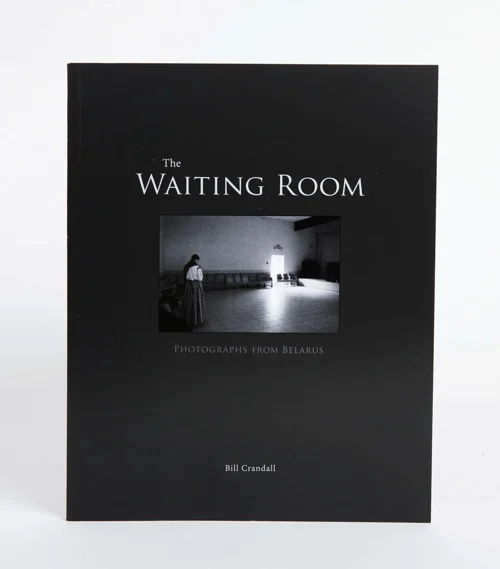
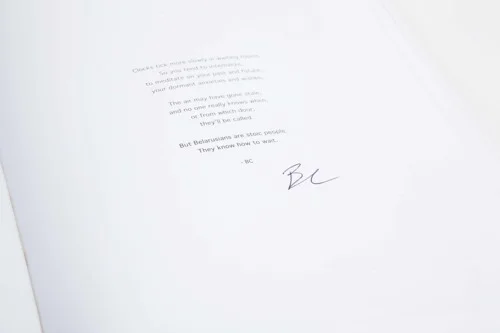


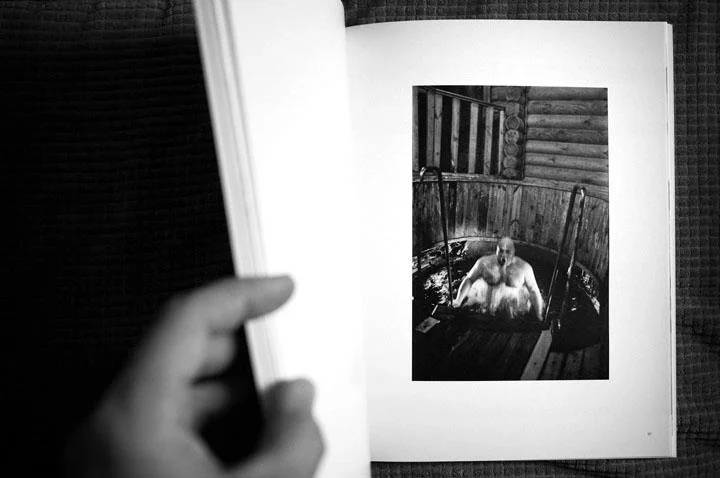
Nice review of The Waiting Room over on the phot(o)lia blog.
http://photolia.tumblr.com/post/20511639880/the-waiting-room-bill-crandall
Belarus, a post-Soviet country “squeezed between Europe and Russia”. The most common association is probably Chernobyl and current political regime referred to as “the last dictatorship in Europe”. No surprise that those few photographers who get to that part of Europe focus on one of those issues. Bill Crandall did something very different. He came to Belarus to document everyday life and he spent one decade visiting the country: observing, learning, reflecting. [S]ome images are just surreal, others are very intimate, many are captivating but all of them create beautiful and intriguing narratives […].

RIP Pancake Mountain
Really sorry to see Pancake Mountain call it quits. See the farewell video here.
Scott Stuckey, the mastermind of the indie children’s show, is a long-time friend. He poured his creative genius into PM, really left it all on the field. So many cool musicians visited the Mountain for the privilege of playing for dancing kiddies and being interviewed by sheep puppet Rufus Leaking. Ian MacKaye wrote the song Vowel Movement for the show, it’s one of the best songs I’ve ever heard for kids (and Scott’s video for it is great). My six-year-old loves it.
But in the end commercial TV just wasn’t biting and you can only keep a labor of love going so long on free labor.
I’m proud to have been a part of PM in the early days, mostly doing still photos but also helping with scripting and whatever else needed doing. It was pretty amazing - one day Henry Rollins would come in for a sketch, the next we’d be filming George Clinton in the alley behind the 930 Club (while the band was still playing inside!), the next we’d be setting up a kids’ dance party with Thievery Corporation.
I can’t say I’m surprised PM didn’t quite make it to the next level, simply because you’d expect resistance and lack of vision from the TV powers-that-be for such a scrappy, quirky, underdog production. But those were the attributes that made it so damn cool. The bands sure ‘got it’ though.
Scott, congratulations and kudos for all that you did achieve with Pancake Mountain. You showed a whole way of doing things - a truly indie/DIY approach that celebrated both music and kids in a totally non-cheesy way that adults could actually stomach as well. Looking forward to whatever comes next!

The Waiting is Over



My book The Waiting Room - Photographs from Belarus is now available in a first edition of 500. The introduction, in English and Russian, is by Belarusian author Victor Martinovich. The book is a ten-year body of work finally achieving final form.
Check here for more info about the book.
Whenever I travel I am so dependent on other people, without whom I couldn’t get anything done. Huge thanks to everyone who helped me so much over the years!

Havel and Me
Almost cried today when I read Havel had passed away. In 2005 I was in Prague briefly and crashed as usual with my friend Karel Cudlin in Zizkov. As always Karel had a lot going on, this particular day was the exhibit opening of his commissioned work shooting backstage at the Czech National Theater for a full season. Afterward we headed over to a restaurant for the after-party. We’re sitting there and suddenly he says, ‘ah, Havel is here!’. Sure enough, over in the adjacent dining room was Vaclav Havel and a little entourage around a table.
Knowing Karel used to be one of Havel’s personal photographers, I shamelessly begged for an intro. 'Yeah, sure!’ Karel said, eyes twinkling as he angled us through the crowd. A moment’s wait, a few words in Czech from Karel, and there I was shaking the man’s hand (Karel managed to step back and get a pic, pardon the motion blur, it was really dark in there and it happened fast). I forget now what I said, but I’m pretty sure it was forgettable. Anyway, I gave him a few small photo prints I happened to have and said goodbye.
That was about it (and plenty). A bit later I stepped outside the restaurant and there was Havel, by himself, talking on the phone on the little Prague side street. I can’t remember if I didn’t have my camera, or would have felt like an ass for using it, but it’s fine as just a memory.
Such a modest, unassuming guy but a real giant, in the league of Mandela (whose time may be drawing near as well I’m afraid). Why are there so few truth tellers of that stature, people who can not only really see through the weeds that others get lost in, but have the talent to express that vision? When you lose one, the world seems suddenly darker. Like we’ve lost a protector, whose mere presence affirms our best - and rebukes our worst - impulses.

VOA Interview
The Voice of America (Russian Service) reported on my Belarus work and upcoming Waiting Room photo book. Unfortunately the links to the main piece and their photo blog don’t exist anymore. But they interviewed me by email (published in Russian), see below for the answers I gave them in English.
—–
How did you decide to start doing photography? What was the starting point?
My father was an artist and photographer. We had a small darkroom in our home, he taught me not just about developing film and how to make a good print, but also how to really see. So this was the very beginning. Until my early 20s I was more into music, I played guitar in various bands and studied music in college. But gradually photography sort of took over my creative interest. I did both for a while but eventually chose photography as my main focus. Though I think a feeling for music still informs my visual side as well. It all goes together.
What kind of camera did you use when you start doing photography?
I started with film cameras, this was before digital existed. My first camera was a Canon AE-1. Later I did much of my personal work with the Leica M6. Now I am doing mostly digital. I made a decision that I needed to find a way to do ‘my thing’ with digital cameras, instead of stubbornly holding onto film. I don’t need a $5000 camera though, I sort of go the other way - working with more modest tools like smaller cameras and phone cameras and trying to maximize them. I very much like some small Ricoh digital cameras that give me the quality I need but allow me to take a nimble, discreet approach. Instead of being the guy with the huge camera doing something serious. More and more in this world, that’s the way to get negative attention. Sometimes I prefer not to be taken seriously by people when I am working.
The work of what famous photographers impresses you the most? Why?
When I started I was very excited by Cartier-Bresson, Josef Koudelka, Marc Riboud… especially Koudelka. He is so uncompromising in his vision. I met him a couple times recently and it was very special for me. His work has a sense of mystery, ambiguity, and suggestiveness that really appealed to me and still does. In fact, I quite like many lesser known Czech photographers, like Viktor Kolar, Vojta Dukat, Bohdan Holomicek, and my good friend Karel Cudlin. Something in the Czech photo DNA I guess. The photographers who impress me are not necessarily virtuosos, but they can make magic out of ordinary subject matter.
Sometimes people say that it’s necessary to go somewhere in order to take pictures. How did you decide to go to Belarus?
I think it’s not so important to go somewhere, although of course the exotic and unfamiliar are more arousing to our senses. Photographing the familiar is harder for sure. Though I’m trying to find fresh ways of seeing what is around me close to home. Either way, it’s more important what is in your mind, what is your sensibility, your point of view. This is influenced by everything, by who you are, by art, film, literature, music…
With all that said, I am very interested in places, and I am driven by the desire to capture the essence of a place. Not literally, but impressionistically, with a point of view. I first went to Belarus as part of my broader project shooting in various parts of Eastern Europe over some years. I’m interested in how different countries have evolved - and are evolving - since the end of communism. There are quite different case studies if you consider places like Prague, Kosovo, Serbia, Ukraine, Belarus… But any broader context is only a kind of backdrop, when I go somewhere I am not trying to work as a news reporter. I’m simply looking for what interests me, what feels true on a universal and enduring level, what is ambiguous instead of literal. I want to understand correctly but not be confined by the need to describe or explain. I guess I am offering impressions not facts, but impressions informed by facts.
How is it possible to capture a moment in order to make a special picture?
Well, it’s necessary to be able to anticipate, to be sensitive, to be in command of your equipment and technique, and to have a kind of inner intensity so that when you respond it’s like a coiled spring being released. It helps to study human nature, and develop your ideas so that when a moment comes along you can even recognize it as 'your’ moment. If you don’t have some idea what you are trying to do, at least some set of ideas you are drawing from, how will you know that a particular moment crystallizes your thoughts in some way?
Why are most of your pictures in black and white?
I’ve always preferred black and white. It distills the scene to the essentials of mood, emotion, composition, etc. It’s more mysterious and I like mystery. Color can be like visual noise if it’s not well-handled, and I don’t think I handle it that well. Though for the past year or so I’ve been doing a color series that I quite like, so maybe I’m getting better.
Do you think there are some special details in the photojournalist’s work, for example in Belarus? Did you get into some extreme situation there and in the USA?
I haven’t really had any special problems in Belarus, no one really bothers me when I’m working. Well, there was one crazy guy who got in my face the first time I was there, but I think he just had anger management issues. But I’m not usually shooting things that are politically sensitive so there shouldn’t really be any issues. The second time I had an exhibition in Minsk showing some of this work, I actually got some positive coverage in the state media. I suppose it’s ironic that I’ve been detained shooting in Washington DC, but not in Belarus. I had gone to take pictures of the Pentagon after September 11. At that time there was surveillance of everyone who came and went there. I spent a long time sitting, waiting, at the site for the right light before I started shooting. Then the next day I came back with my wife, who is a radio and TV reporter. Some soldiers thought we were suspicious and questioned us for a little while. Made me miss my good light!
There are so many incredible and interesting and funny experiences and people you meet when you do this kind of independent work. It might be boring to talk about them. It’s like older people who tell war stories, the memories are powerful for them but not necessarily for others. On the other hand, photographing in another place can often be quite lonely, even depressing, to wake up each morning, maybe not feeling well or whatever, trying to figure out what you will do that day to move your project toward success.
Do you think that the world has changed? And working in the style of Cartier-Bresson is very difficult since there are a lot of privacy concerns?
Yes, in many places it has become harder to work as a street photographer, though snap-and-run is a relatively small part of what I do. Often it’s more about being able to work my way into situations or scenarios that allow for some degree of at least unspoken permission or tolerance from the people around me. It’s never been easy, plus now there are so many real or imagined security concerns. It’s a complicated subject, this whole new landscape of privacy, security, the internet, etc. But often people are flattered to have their picture taken, as long as they feel you don’t have some kind of negative agenda. You have to be transparent, open in your intentions, this can be felt despite language barriers.
There is an opinion that photography is the art of one thousand details, for example, the organization of the trip. How do you get ready for the trip? Is it possible to compensate all spending?
Well, first of all, I am rarely compensated for any spending! At least not right away, and not always in the form of direct payment. Grants can help, I’ve had a couple that made a big difference. But karma has a way of working, efforts are often re-paid in unexpected ways.
It’s true that maybe 80 percent of the effort is putting yourself in the position to even have a chance to make a good photo. Then you try not to screw it up. I personally don’t plan every detail of a trip, a lot is left to fate. Of course the basics are in place, but sometimes even where I will sleep, where I will go, can be subject to change. On another level, getting ready for a trip involves a certain mental preparation, including a certain amount of preconceiving what I’m looking for. But once I’m working, I try not to think too much, I try to respond intuitively.
With what famous magazines or publishers did you work?
I worked a lot for many years for the Washington Post, New York Times, and many other newspapers. I’ve been published in many magazines in the US and Europe, though usually from assignments they give me, not my own projects. I consider myself a reformed/former photojournalist, now pursuing my own projects is all that’s really important to me. It’s fine and nice when a publication presents your work, and that used to drive me. But I think you can only take your photography to the next level when you stop worrying about whether it will fill an editor’s need.
What is the range of payment for photographers who work for famous magazines or publishers?
In general the rates for newspapers are quite low, and the contract terms are not to the photographer’s advantage. Magazines pay more, but the whole industry is of course declining. It’s a very difficult time for those who are used to relying on income from magazine assignments. I have a teaching job now, so that gives me less time to shoot, but less financial pressure. I’m working on a few projects but for the short term future, I’m more concerned with shaping the work I’ve already done and getting it out there. In addition to The Waiting Room, I’ve got a couple other books I’m planning to self-publish. Self-publishing is a whole separate conversation.
What kind of camera do you use now?
The last time I used the Leica with film was in spring of 2009, in Belarus. I’m not saying I’ll never shoot film again because I like film. But I’m pretty comfortable now using my little Ricohs when I go off to work on a project (or even for most local assignment work from clients). Specifically, I have two Ricoh GXR cameras, one with a wide angle, one with a normal lens. I never use zooms. I have used the Ricoh GRD series point and shoot cameras quite a lot. I can hang the results next to my Leica shots with no problems. But I’m not really into equipment. You need the right tool that you enjoy using, but it’s just a tool.
What is the recipe for success?
You can’t really worry about success. Don’t worry about 'being a photographer’. Worry about your craft and your vision, and realizing that you are up against the best in the world. We are saturated in pictures, many are wonderful, yet so many are mediocre or worse. Mediocrity won’t cut it. So be relentless and self-critical. You have to be great. If you are not, don’t kid yourself because of ego or whatever. Either figure out how to get better or go do something else. We have enough images in the world, in fact many more than we need. We don’t need the technically perfect, the banal, the superficial, the outlandish.
I don’t know the definition of success, let alone the recipe. But I would say develop your own vision, think of yourself as a visual author. Develop your ideas and your sensibility. I tell my students the only reason we need more photos in the world is if they are YOUR photos. So, you have to figure out what that means and how to achieve it. Then do it, and keep doing it.
Also, I personally think we have too much, not too little, photography that shows what is wrong with the world, under the idea that you are creating awareness. I’m not telling people NOT to do this, because of course awareness is important. But I saw the last World Press exhibit and very little of it was interesting to me. So much of it was very hard to look at on a human level, and just made me tired. We already know the world is fucked up, in countless ways. We cannot sugar-coat reality; as a great photographer friend of mine said, sentimentality won’t save us. But photography, for me, is about so much more than just showing the problems of the world. Ok, maybe I tend to have melancholic atmospheres and textures in my work. But I am neither a nihilist nor a romantic. I’m not setting out to show the negative or the positive. We need to be critical but not cynical. We have to avoid kitsch at all costs, but I am not embarrassed about the word humanism. Photography should have humor, hope, beauty, wonder, poignancy, and of course mystery. Because life is above all mysterious, right?

Fotoweek Talk
I’ll be giving a presentation and talk tomorrow (Sat) at 11am, kicking off FotoWeekDC’s lecture series in the former Borders space downtown. I’ll show work from The Waiting Room, my 10-year project in Belarus looking at this little-known country on the edge of Europe. The book should be out shortly (I’d hoped to have it by tomorrow but it was not to be). In the meantime, anyone who attends will get a free copy of the e-book version.
The place is massive and is decked out with cool photography, worth a look anyway. Hope you can join me!
Wings of Desire
Since I started teaching in 2008, I haven’t really had a true summer break. Various family matters have always seemed to take over right on cue. I actually finished the week before last, but last week my daughter had not yet started summer camp. So today I mark as the first real day of summer. Meaning hours each day - actual blocks of time - to rest, think, have coffee, read, and of course immerse in long-neglected creative efforts like publishing my Belarus book, making music, developing some web projects, etc.
So I watched Wings of Desire again the other day on DVD - as normal creative sustenance, to revisit the late Peter Falk’s role, and to see how it all holds up. Man, not only does it hold up, it’s perhaps gotten better since it was made in the 80s. Then I watched it again today, this time with the running commentary by Wim Wenders and Falk switched on.
My goodness I’m glad I did. In a gentle, almost languid way, they (mostly Wenders but Falk too) provide beautiful and often profound insight into so many new layers of the film. You will make connections you didn’t perceive before, more fully appreciate the truly amazing BW cinematography, and grasp what a miraculous and unique movie it really is:
That Wenders was working without a script or storyboards. That the circus was named for Henri Alekan, the film’s cinematographer (of Roman Holiday and La Belle et la Bête fame, among many others). That many of Peter Falk’s scenes - like sketching the old woman, and trying on all the different hats - were based on things Falk himself was doing anyway on set. How much of a historical document the film has become with all the recent changes in the Berlin cityscape. That Solveig Dommartin did all her own trapeze work, all without a net even during training, and once badly fell. That there was an alternative ending with Cassiel, the other angel, becoming human too.
And don’t reach for the remote during the closing credits, Wenders keeps talking and it’s fairly mind-blowing. As the credits roll, the first thing that appears is a dedication to ‘Yasujiro, François, and Andrej’. He explains it’s a reference to directors Ozu, Truffaut, and Tarkovsky, and how their work inspired him. It’s an exquisite moment. I recently discovered the complicated, spiritual genius of Tarkovsky (thanks Gabriela and Mark!) and could totally see what he meant.
I had to post all this right away, while my synapses are still smoking. Maybe this is all ho-hum or too precious for some people. Whatever, that’s their loss to dismiss moments such as these, when something you thought you knew suddenly takes on a whole new life and richness, and makes transcendent creative connections that are universal, of the highest order.
Ah, summer break. Nice way to start.

for de Volkskrant (Amsterdam).
NYC’s Evolving Bikescape
NYC for de Volkskrant

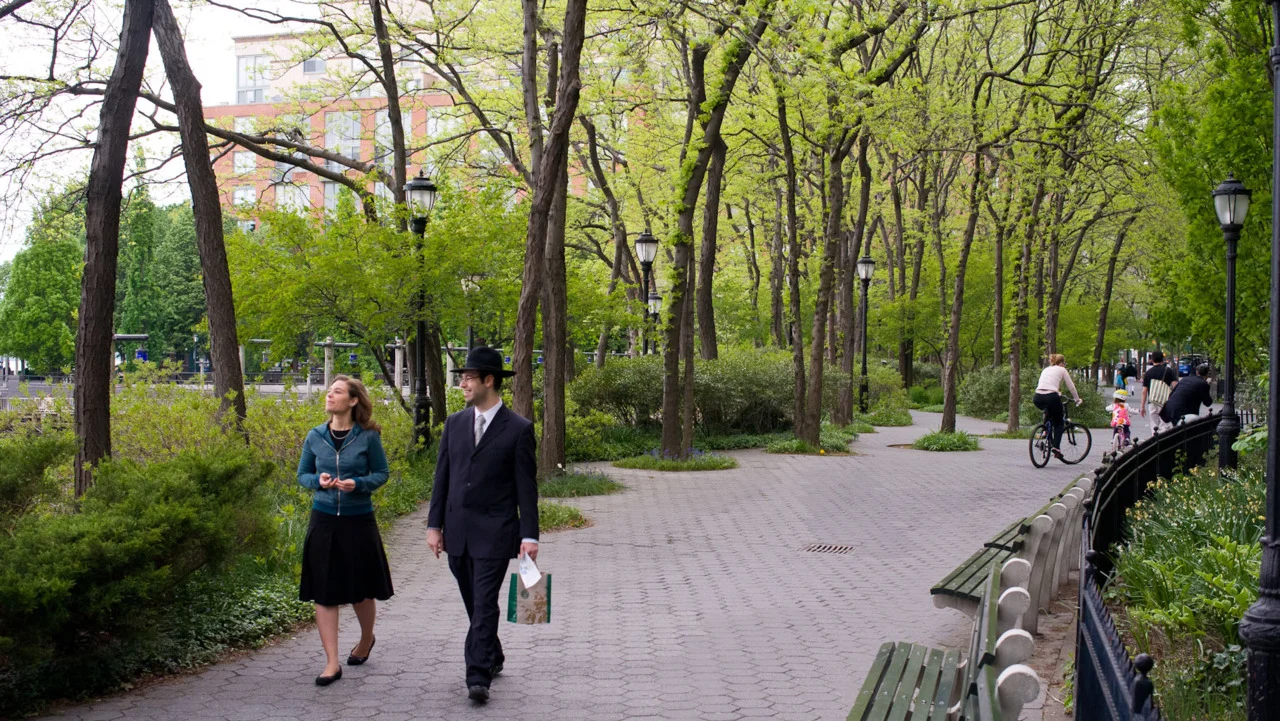


Before last weekend, I don’t think I had ever taken a single picture in New York City. Nothing of consequence for sure, but literally I may have taken less than five frames there, total, in my life, except for casual pictures of friends.
Strange I guess, but I always felt the same way as I feel about Paris - what in the hell am I going to shoot there that hasn’t been done a million times? In Paris I did sort of figure out a little hook for a short series a few years ago. In New York I’ve never even had the urge to try. Gun firmly in holster. I can’t really explain it.
So when a Dutch newspaper asked me to do some photos for a little travel piece about changes in lower Manhattan, it was both exciting and a little daunting. I’d have one day (well, much less after the train to and from DC the same day). So in the end it was lunchtime to dusk.
Thank god it was good weather and I was with the reporter, a great guy who skillfully steered us to choice spots. On top of everything I wasn’t feeling too great, so that’s a bummer when you’re praying your energy won’t fail you.
I used the opportunity to take the leap and shoot it all with my little Ricohs. Not to be a gearhead, but I’m loving working with the GRD and GXR in tandem. Just a 28 and a 50, light and nimble, great quality, and you come off as non-serious, a curious goofball, which can be a good thing when working on the street.
It was a pretty good day in the end. Of course I was shooting what was needed for the job, but I gave myself total license to have fun and shoot how I wanted. I found it interesting what some of the pics ended up reflecting - the ongoing transformation of NYC into a properly groomed city. I remember the 80s when you’d arrive in New York and it just seemed hopeless, unredeemable. The seedy and the funky and the shitty and the bohemian and the thrilling are largely gone. What was worst and best about the place.
But from an urbanistic point of view, what has come along with the tourists and soulless kitsch of places like Times Square (which, come on, was always kitsch, formerly just with enough danger and scruff to make it interesting) are some world-class improvements. I was pretty impressed with the subtle vibe in places like Battery Park, DUMBO, around the WTC, the new pavilion around the Staten Island ferry terminal…
There is, dare I say it, an emerging urban grace amid the city’s muscular exoskeleton.
I Saw Ah-nold


Driving home this evening I spotted ol’ Arnold Schwarzenegger cruising west on the Pennsylvania Avenue cycletrack, right below the Capitol. Caught up to him on Constitution to make sure I had a clear shot from the car. I know, Citizen Paparazzi. Apparently the former governator had a meeting earlier in the day with Obama about immigration reform.

FotoDC/Flash
The press/VIP night for FotoDC’s big FLASH exhibit is tomorrow (Thurs) night, with the public opening Friday night in Crystal City, VA. Click here for more info.
There was a panel of five jurors from the top tier of the DC photo world - a short selection from my Belarus series (including the above pic from Minsk in 2009) was chosen by Philip Brookman, chief curator at the Corcoran Gallery of Art. Which is obviously exciting, though my one complaint was that each person submitting work only had eight minutes with their chosen curator, about enough time for how-you-doing and a quick slideshow before an official hoverer moved in to break things up. Brookman is certainly someone I would’ve liked to get into more of a conversation with.
But I nitpick. It’s great how FotoweekDC has become the year-round FotoDC, pulling together all kinds of cool events like this. Kudos to founder Theo Adamstein and crew, working hard to put the DC photo scene on the international map.
Scholastics Awards
Super excited, today I learned that seven (!) of my photo students won awards from the Alliance for Young Artists and Writers. Including one girl who was awarded for her great portfolio (most are for single images). The AYAW Scholastic Awards are very prestigious and have helped launch young artists for decades. Past winners have included Andy Warhol and Richard Avedon as teenagers.
Review
What are the film, music, and book experiences that you most connected with in the last year? Not that came out in 2010 necessarily, but that you saw/heard/read in the last year. Work that not only entertained but somehow elevated to essential creative nourishment/inspiration, maybe even infused into your own work somehow.
Ok, mine:
Film - The Road (in a tie with Secret of Kells)

The Road, from the book by Cormac McCarthy, is a literate, spare, somber, monochrome, post-apocalyptic thriller. The, um, cannibalism theme aside, the father-son dynamic is so powerful and profound, I don’t know how I got through this one at a time when my own father was gravely ill. Surprisingly, I didn’t find this film depressing at all, it’s actually strangely beautiful. But then again I have a strong stomach for quality melancholia.

Secret of Kells is simply a thing of beauty. The eye-candy of the animation would have been enough, but married to an intelligent, nuanced, non-sentimental sense of culture and myth it acquires layers that most films of any kind don’t have. People who criticize the supposedly thin storyline are missing the point. [It’s good for kids, but be careful - when the vikings finally arrive and get straight to business, there are some very scary moments. Though not much worse than Disney can be at times, or those flying monkeys in Wizard of Oz.]
I know, the two films couldn’t be more different on the surface. But thinking just now, I realize they are actually sort of the same. A boy and his father (or father-figure in Kells), trying to find hope and light in the face of primal threats.
~
Music - Jonsi concert at 930 Club

My friend and I agreed the Jonsi show was like hearing music that was perhaps 10 or 20 years ahead of the curve. I loved the unconstrained inventiveness of the individual musicians - especially the drummer, my god, but others in more subtle ways - the stage set and projections that conjured nature, dreams…
And of course Jonsi’s music, which even at its most ethereal seemed to break free of the lead weight that can sometimes bog down Sigur Ros’ material. It could spring to life with a surprisingly exuberant charm that really was, to use the dreaded term, uplifting.
~
Book - Moominland Midwinter

Yes, I know, my Moomins fixation again. My daughter isn’t quite ready for the original storybooks, but I sure was, especially as an antidote to Dora saturation.
The Moomin family are hibernating through the winter months, as Moomins do. But young Moomintroll wakes up somehow, and he can’t get back to sleep or rouse any of his family. So, all alone at first, he sets out to discover the mysteries of rural Nordic winter. Eventually he has a series of minor-key adventures with a set of interesting and often elusive creatures and characters taking winter refuge nearby. Finally spring comes and everyone wakes up, just as he’s getting the hang of the winter world.
Maybe doesn’t sound like much, but Finnish author and illustrator Tove Jansson is a quirky, unsentimental master of atmosphere, tone, and character. Yes, it’s for kids but it’s unafraid to be dark in interesting ways. There’s a kind of mystical art in here if you’re receptive to it. If you’re a parent who can’t stand the usual crap of modern kids’ books and TV for one more second, this book is pure tonic. A great adult read, especially in winter.
~
I’ve been working on a couple of projects that have definitely been watered by little elements of all of these. Though probably (hopefully) not in obvious ways. Stand by, they’re both unfinished but I hope to roll them out sometime soon!